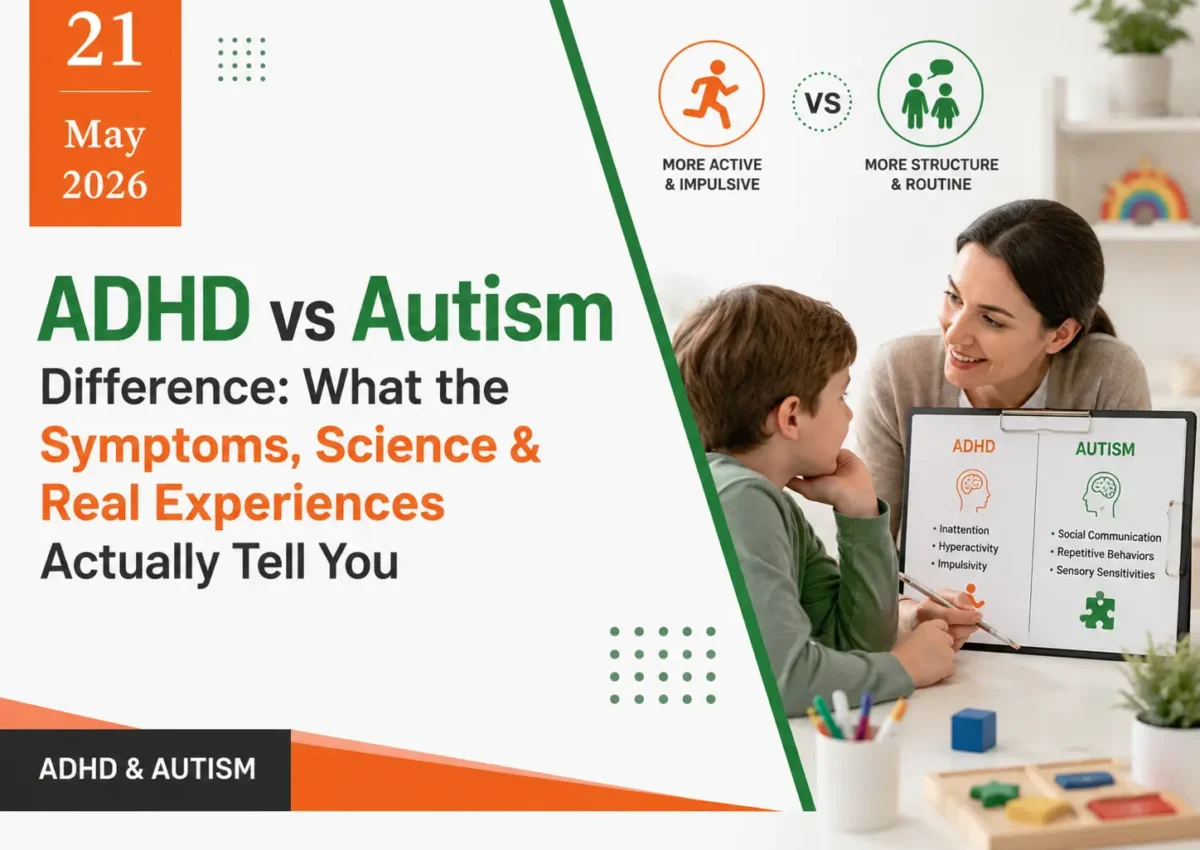
They look alike. They get confused all the time. And for millions of families, the question — is this ADHD or autism? — takes years to answer.
Both conditions affect how the brain processes attention, communication, and behavior. Both show up in childhood. Both are more common than most people think. And yet ADHD and autism are distinct neurodevelopmental conditions with different causes, different diagnostic criteria, and very different treatment paths.
Getting the distinction right matters — not for labeling, but for access to the right support at the right time.
This guide breaks down the real ADHD and autism difference: what separates them, where they genuinely overlap, how they show up differently in children versus adults, and what it means when someone has both.
What Is ADHD? (The Core Definition)
ADHD — Attention-Deficit/Hyperactivity Disorder — is a neurodevelopmental condition defined by persistent patterns of inattention, hyperactivity, and impulsivity that interfere with daily functioning across multiple settings.
It comes in three presentations:
- Predominantly Inattentive — easily distracted, forgetful, poor time management, difficulty sustaining focus
- Predominantly Hyperactive-Impulsive — excessive movement, interrupting, acting before thinking
- Combined — both sets of symptoms present simultaneously
According to 2024 CDC data, approximately 11.4% of U.S. children ages 3–17 have received an ADHD diagnosis — roughly 7 million kids. In adults, conservative estimates put prevalence at 4–5% globally, though late diagnosis remains common, particularly among women.
What ADHD is not: a deficit of intelligence, a failure of discipline, or a childhood phase that disappears at 18. Long-term studies show that in one-third to two-thirds of children with ADHD, symptoms persist well into adulthood.
What Is Autism? (The Core Definition)
Autism Spectrum Disorder (ASD) is a neurodevelopmental condition characterized by persistent differences in social communication and interaction, alongside restricted, repetitive patterns of behavior or interests.
The word “spectrum” is important here. Autism doesn’t look the same in any two people. Some autistic individuals are highly verbal and academically accomplished. Others have significant communication support needs. Sensory differences — hypersensitivity to sound, light, touch, or smell — affect roughly 9 in 10 autistic people, though this isn’t a diagnostic requirement.
The CDC’s 2025 ADDM Network data places autism prevalence at approximately 1 in 31 eight-year-olds in the United States. That’s a meaningful increase from prior years, driven partly by broader diagnostic criteria and greater clinical awareness, not necessarily a true epidemic.
Before 2013, Asperger’s syndrome, autistic disorder, and pervasive developmental disorder (PDD-NOS) were all separate diagnoses. The DSM-5 folded them all under the single umbrella of Autism Spectrum Disorder.
The Major ADHD and Autism Difference: Core Diagnostic Distinctions
Here’s the clearest way to understand the separation:
The simplest anchor: ADHD is fundamentally about attention and self-regulation. Autism is fundamentally about social communication and repetitive patterns.
The reason these two get conflated so often is that both can make school difficult, both can affect friendships, and both can make a child look “different” in a classroom — just for entirely different underlying reasons.
Where ADHD and Autism Overlap And Why It’s Confusing
Here’s what the research makes clear: these conditions genuinely share biological and behavioral territory. They are not the same, but they are not neatly separate either.
Shared features between ADHD and autism include:
- Executive dysfunction — challenges with planning, organization, and task completion
- Emotional dysregulation — difficulty managing big emotions, mood swings, rejection sensitivity
- Sensory differences — though more consistent in autism, sensory sensitivity appears in many people with ADHD too
- Sleep problems — both conditions are associated with disrupted sleep architecture
- Social struggles — different origins, similar outcomes in terms of friendship difficulties
A clinical study using the ADOS-2 (a gold-standard autism observation tool) found that children initially referred for autism but later diagnosed with ADHD showed measurable autistic-like traits — particularly in social affect. The line between conditions isn’t always clean, even with specialist tools.
The most critical overlap data point: more than 50% of autistic people also meet criteria for ADHD. Conversely, up to a quarter of children diagnosed with ADHD show low-level signs of autism. These aren’t coincidences — both conditions share significant genetic risk factors and affect overlapping brain systems, particularly executive functioning networks.
ADHD and Autism Difference in Children: What Parents Should Watch For
This is the question that brings most parents to this topic in the first place: Is my child ADHD or autistic?
Both conditions can surface early. Autism signs are sometimes visible before a child’s second birthday — limited eye contact, not responding to their name, absent social smiling. ADHD tends to become more apparent around preschool or early school age, when sustained attention and behavioral control are suddenly required.
Key behavioral differences to observe in children:
Social interaction: A child with ADHD typically wants to connect with peers but struggles to maintain it — they interrupt, lose focus mid-conversation, or act impulsively in ways that frustrate others. The desire for social engagement is usually present.
An autistic child may not seek out social interaction in the same way, or may engage differently — on their own terms, focused on their interests, less tuned in to social reciprocity. This isn’t aloofness; it’s a fundamentally different social orientation.
Attention patterns: ADHD produces scattered, inconsistent attention — difficulty sustaining focus on anything that doesn’t offer immediate stimulation. An autistic child, by contrast, may hyperfocus intensely on one narrow area of interest while being completely unable to engage with everything else.
Put simply: an ADHD child struggles to focus on their homework and yours. An autistic child might know every classification of dinosaurs down to subspecies, but can’t engage with a subject that holds no personal interest.
Language: Children with ADHD typically develop language on schedule. They may talk excessively, interrupt, or blurt — but the language itself is there. Autistic children may show speech delays, use language in atypical ways (echolalia, scripting from TV shows), or struggle with figurative and non-literal language throughout their lives.
Routines and change: An ADHD child may resist routines because they find them boring. An autistic child often needs routine and can experience genuine distress — not defiance — when schedules change unexpectedly. The surface behavior might look similar. The emotional mechanism underneath is different.
If you’re unsure about your child’s presentation, the starting point is always a conversation with your pediatrician. A proper evaluation for either condition involves behavioral observation across multiple settings, input from parents and teachers, and ruling out other explanations. The M-CHAT (Modified Checklist for Autism in Toddlers) is a validated, freely available screener for children ages 16–30 months worth discussing with your doctor.
ADHD and Autism Difference in Adults: The Late Diagnosis Reality
Adults are getting diagnosed with ADHD and autism at unprecedented rates. And while that’s partly down to better awareness, it also reflects how profoundly these conditions were missed in previous generations — especially in women.
For adults, the ADHD and autism difference often manifests in professional life:
An autistic adult may be exceptionally skilled at detail-oriented work, but struggle with unspoken workplace politics, adapting to sudden changes in process, or reading between the lines in emails. Their challenges are rooted in social interpretation and flexibility.
An adult with ADHD may be creative, broadly capable, and socially intuitive — but chronically late, overwhelmed by administrative tasks, inconsistent in output, and unable to sustain momentum on projects that don’t actively engage them. Their challenges are rooted in self-regulation and executive function.
Adults in both groups are frequently misdiagnosed first. Common misdirects include:
- Anxiety disorder (both ADHD and autism can produce anxiety as a downstream effect)
- Depression (executive dysfunction and burnout from masking look like low motivation)
- Borderline Personality Disorder — particularly common misdiagnosis in women with autism or AuDHD
Studies estimate that the co-occurrence of ADHD and autism in adults sits between 20–37%, though research specifically tracking adult presentations remains limited compared to the child literature.
Autism vs ADHD in Females: The Diagnostic Gap That Still Exists
This is one of the most significant content gaps in the literature — and one of the most consequential.
Research suggests that up to 80% of autistic females may go undiagnosed by age 18. Women with ADHD are also disproportionately missed because their symptoms tend to be internalized — anxiety, self-doubt, exhaustion — rather than the overt hyperactivity that historically drove referrals.
The core reason: diagnostic frameworks for both conditions were built primarily on observations of male behavior.
A girl with autism will often “mask” — learning to imitate neurotypical social behavior well enough to pass. She may make eye contact, sustain conversation, and appear to have functional friendships. What’s invisible is the enormous cognitive effort that takes, and the crash that comes after social situations.
A girl with ADHD may be described as dreamy, distracted, or sensitive rather than disruptive — and because she isn’t flipping chairs or failing every class, she flies under the radar.
The AuDHD (autism + ADHD combined) presentation in women is particularly complex. The ADHD drive for novelty and social engagement can mask autistic traits, while the autistic need for structure can make the ADHD look more contained. The result: a woman who appears functional but is internally running two competing neurological operating systems simultaneously — and burning out doing it.
As one clinical psychologist put it after her own late diagnosis at 35: “I’m constantly double-booking appointments. I’m always late. I interrupt people a lot.” Recognition of ADHD and autism in women has improved, but the diagnostic gap remains significant.
Can You Have Both ADHD and Autism? Understanding ADHD
Yes. Definitively and commonly.
Before 2013, the DSM-IV explicitly prohibited dual diagnosis — clinicians had to choose one. The DSM-5 reversed this, and the clinical data since has been striking. Depending on the population studied, 42–50% of autistic individuals also meet full criteria for ADHD.
The term AuDHD — used informally in neurodiversity communities and increasingly in clinical discussions — describes this combined presentation. It’s not an official diagnosis, but it captures a real and distinct experience.
What AuDHD can look like in practice:
- Intense, sustaining focus on special interests (autistic hyperfocus) combined with an inability to manage administrative tasks (ADHD executive dysfunction)
- Craving routine while simultaneously feeling restless and bored within that routine
- Career instability: exceptional at the actual work, overwhelmed by the bureaucratic scaffolding around it
- “Boom and bust” productivity cycles — periods of intense output followed by complete collapse
One important clinical note: when stimulant medications are used to treat ADHD in someone who also has autism, the response is often different. Stimulants (methylphenidate, amphetamine) may be less effective and can produce side effects — including increased irritability and social withdrawal — more frequently than in ADHD-only presentations. This is why accurate dual diagnosis matters for treatment, not just for identity.
Is ADHD a Spectrum? And Other Questions People Are Actually Asking
Is ADHD a spectrum? ADHD is not formally classified as a spectrum in the way autism is, but it absolutely exists on a continuum of severity. The three presentations (inattentive, hyperactive-impulsive, combined) can shift over time, and the degree to which symptoms impair daily life varies enormously from person to person.
Are ADHD and autism the same thing? No. They share neurological overlaps and frequently co-occur, but they have distinct diagnostic criteria, different primary deficits, and often require different interventions. One does not cause the other.
Which is “worse” — ADHD or autism? This framing isn’t particularly useful. Both conditions exist on a severity spectrum. Both can be associated with significant challenges or, with the right support, with rich and successful lives. The more meaningful question is: what does this individual need, right now?
How do you control ADHD and autism? “Control” may not be the most helpful word, but effective management strategies exist for both:
For ADHD: stimulant medications (first-line for most), behavioral therapy, executive function coaching, environmental modifications, exercise (meta-analyses show meaningful benefits for attention in children), and structure-based strategies.
For autism: Applied Behavior Analysis (ABA), speech and language therapy, occupational therapy for sensory processing, social skills training, and for co-occurring anxiety or mood issues, appropriate psychiatric support. No medication currently treats core autism symptoms directly, but medications can address co-occurring conditions.
When both are present, treatment is more nuanced and should involve specialists experienced with dual presentations.
How to Get a Proper Assessment
For children: Start with your pediatrician. From there, referrals typically go to developmental pediatricians, child psychiatrists, or clinical psychologists specializing in neurodevelopmental conditions. Formal autism assessment often uses the ADOS-2 and ADI-R. ADHD evaluation involves behavioral rating scales across settings, developmental history, and ruling out other conditions.
For adults: Adult assessment for both conditions requires clinicians experienced with how these disorders present in grown-up life — not textbook childhood descriptions. Neuropsychological testing, clinical interviews, and sometimes collateral information from family members who knew you as a child are all part of a thorough evaluation.
One clear rule: online quizzes are useful for awareness, not diagnosis. If you’re asking do I have autism and ADHD after reading this, the answer is to find a qualified clinician, not a 15-question self-test.
The Bottom Line
The ADHD and autism difference comes down to this:
ADHD is primarily a disorder of attention regulation and impulse control. The core challenge is regulating the self — staying focused, stopping before acting, managing time and emotion.
Autism is primarily a difference in social communication and a tendency toward repetitive patterns and restricted interests. The core experience is a different way of perceiving and engaging with the world — not a broken one, but a different one.
They overlap. They co-occur at high rates. They’re both underdiagnosed, particularly in women. And both deserve accurate identification — because the right diagnosis isn’t a label. It’s a door.
Frequently Asked Questions
What is the major difference between ADHD and autism? ADHD is defined by inattention, hyperactivity, and impulsivity. Autism is defined by differences in social communication and restricted, repetitive behaviors. Both conditions can affect attention and social skills, but for different underlying reasons. A child with ADHD struggles to focus due to poor attention regulation; an autistic child may intensely focus on specific interests but struggle to engage with topics they don’t care about.
Is my child ADHD or autistic? It’s not always one or the other — both can coexist, and roughly 42–50% of autistic children also meet criteria for ADHD. A formal evaluation by a developmental pediatrician, child psychiatrist, or clinical psychologist is the only reliable way to distinguish between the two and identify which supports your child needs.
Is ADHD a spectrum? ADHD is not formally classified as a spectrum the way autism is, but it exists along a continuum of severity. Its three presentations — inattentive, hyperactive-impulsive, and combined — can vary over time and look very different from person to person.
How do you manage autism and ADHD together? When both conditions are present (sometimes called AuDHD), treatment requires a tailored approach. Stimulant medications may be used for ADHD but can produce different effects in autistic individuals and require careful monitoring. Behavioral therapy, occupational therapy, executive function coaching, and environmental adaptations all play roles. A clinician experienced with dual presentations is essential.
Can adults be diagnosed with ADHD and autism for the first time? Yes, and this is increasingly common. Both conditions were historically underdiagnosed in adults, particularly women. Many adults receive their first diagnosis in their 30s, 40s, or even later — often triggered by a child’s diagnosis prompting their own self-recognition.
If you found this helpful and want to explore assessment options or support resources for yourself or your child, speak with a healthcare provider familiar with neurodevelopmental conditions. Early, accurate diagnosis is the foundation for everything else.