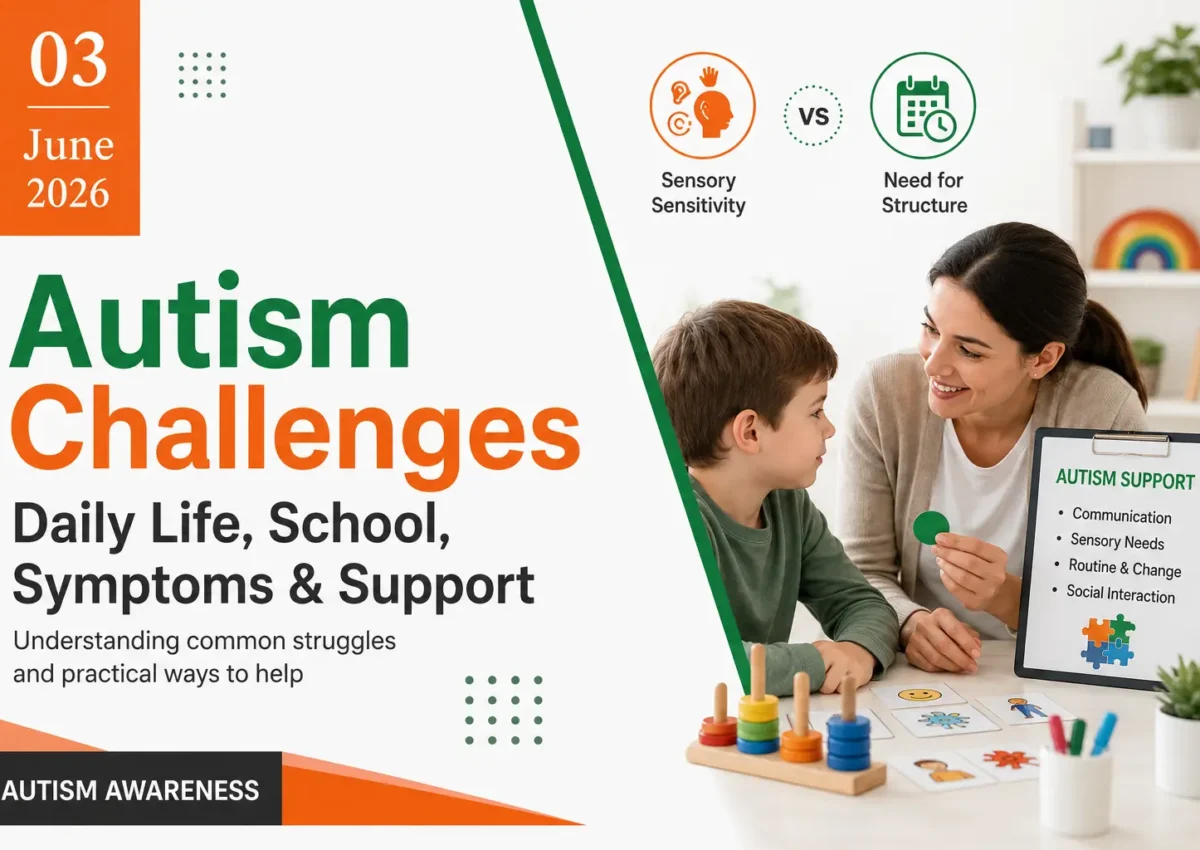
Autism Challenges: Daily Life, Classroom, Symptoms & Support
Autism challenges can affect communication, learning, behaviour, sensory comfort, relationships, and daily routines. But autism does not look the same for everyone. One child may struggle with classroom noise. Another may find eye contact uncomfortable. An autistic adult may manage work well but feel exhausted after social interactions.
Understanding these challenges is the first step toward better support. When parents, teachers, caregivers, and communities understand why certain behaviours happen, they can respond with patience instead of pressure.
This guide explains the common challenges of autism in everyday life, classrooms, adulthood, symptoms, treatment options, and practical ways to support autistic individuals with dignity.
What Does Autism Mean?
Autism, also called autism spectrum disorder, is a developmental condition that can affect how a person communicates, learns, interacts socially, processes sensory information, and responds to changes in routine. The Centers for Disease Control and Prevention describes autism spectrum disorder as a developmental disability that can cause social, communication, and behavioural challenges.
The word “spectrum” is important. Autism is not one fixed set of behaviours. It can look different from person to person.
Some autistic people may speak fluently but struggle with social cues. Some may use very few words or communicate through gestures, pictures, or assistive devices. Some may need high support in daily life, while others may live independently but still face hidden challenges.
Autism is not caused by poor parenting. It is not a behaviour problem. It is a neurodevelopmental difference that affects how the brain understands and responds to the world.
What Are the Main Autism Challenges?
The main autism challenges usually involve social communication, sensory processing, restricted or repetitive behaviours, emotional regulation, learning differences, and daily living skills. These challenges vary based on the person’s age, environment, support system, and individual needs.
| Challenge Area | What It Can Look Like |
| Social communication | Difficulty understanding tone, body language, facial expressions, jokes, or conversation flow |
| Sensory processing | Strong reactions to noise, light, touch, smell, taste, clothing texture, or crowded places |
| Routine and transitions | Stress when plans change suddenly or when moving from one activity to another |
| Emotional regulation | Meltdowns, shutdowns, anxiety, frustration, or difficulty explaining feelings |
| Learning and attention | Different ways of processing instructions, classroom tasks, or workplace expectations |
| Daily living skills | Challenges with eating, sleeping, dressing, hygiene, travel, or personal safety |
| Social relationships | Difficulty making friends, maintaining relationships, or understanding social rules |
The World Health Organization explains that autistic people may have differences in social interaction, communication, behaviour, transitions, attention to details, and reactions to sensations.
The biggest challenge is often not autism itself. The bigger challenge is living in environments that do not understand autistic needs.
Challenges of Autism in Everyday Life
Challenges of autism in everyday life can include sensory overload, communication difficulties, changes in routine, sleep problems, food sensitivities, social pressure, and difficulty managing daily tasks. These challenges may happen at home, school, work, public places, or social gatherings.
For many autistic people, everyday situations can require more energy than others realise.
A simple family function may include loud music, bright lights, strong smells, unfamiliar people, forced greetings, and unexpected conversations. A trip to a supermarket may involve crowd noise, flashing signs, long queues, and too many choices. A small change in routine can feel stressful because predictability helps the person feel safe.
Common daily life challenges include:
- Difficulty explaining needs clearly
- Feeling overwhelmed in noisy or crowded places
- Strong preferences for certain foods, textures, or routines
- Trouble sleeping or following bedtime routines
- Difficulty with personal care tasks such as brushing, bathing, or dressing
- Anxiety when plans change suddenly
- Difficulty understanding social expectations
- Exhaustion after social interaction
- Trouble shifting from one activity to another
These challenges should not be seen as laziness, stubbornness, or bad behaviour. Many autistic people are trying to cope with a world that feels too loud, too fast, or too unpredictable.
The right support can make daily life easier. Clear communication, visual schedules, calm spaces, predictable routines, and sensory-friendly environments can reduce stress and improve participation.
Challenges of Autism in the Classroom
Challenges of autism in the classroom can include sensory overload, difficulty following instructions, trouble with group work, social misunderstandings, changes in routine, handwriting difficulties, anxiety, and difficulty staying focused in busy environments.
A classroom can be a demanding place for an autistic child. It may include bright lights, ringing bells, loud students, unclear instructions, fast transitions, and pressure to behave like everyone else.
Some children may understand the lesson but struggle to show what they know. Some may find writing difficult but answer well verbally. Some may need extra processing time before responding. Others may struggle during unstructured periods such as lunch breaks, sports, or group activities.
Common autism challenges in the classroom include:
- Difficulty understanding long verbal instructions
- Sensory discomfort from noise, lights, uniforms, or classroom materials
- Anxiety during exams, assemblies, or timetable changes
- Trouble participating in group work
- Difficulty reading peer behaviour or sarcasm
- Meltdowns or shutdowns after sensory overload
- Repetitive movements that may be misunderstood by teachers
- Difficulty moving between classes or activities
- Strong focus on one topic or activity
- Difficulty asking for help
Teachers can support autistic students by using clear instructions, visual aids, predictable routines, quiet corners, flexible seating, and extra response time. Support works best when teachers focus on understanding the reason behind behaviour instead of only correcting the behaviour.
A child who covers their ears may be overwhelmed by sound. A child who avoids group work may be anxious. A child who refuses a task may not understand the instruction clearly.
When classrooms become more predictable and inclusive, autistic students can learn with more confidence.
Autism Symptoms: What Are the 3 Main Symptoms of Autism?
The three main symptom areas of autism are social communication differences, restricted or repetitive behaviours, and sensory or routine-related differences. The CDC notes that autistic people often have challenges with social communication and interaction, restricted or repetitive behaviours or interests, and different ways of learning, moving, or paying attention.
- Social Communication Differences
Autistic people may communicate differently. Some may speak less, avoid small talk, repeat words, speak in a very direct way, or struggle to understand facial expressions, tone, or body language.
This does not mean they do not want connection. It means their communication style may be different.
- Restricted or RepetitiveBehaviours
Some autistic people may repeat movements, words, sounds, or routines. These behaviours can help with comfort, focus, or emotional regulation.
Examples include hand-flapping, rocking, repeating phrases, arranging objects, or wanting the same routine every day.
- Sensory Differences and DifficultyWithChange
Autistic people may be over-sensitive or under-sensitive to sound, light, touch, smell, taste, temperature, or movement.
A sound that feels normal to one person may feel painful to another. A small change in routine may create real distress because predictability helps the person feel safe and prepared.
Why Is Eye Contact a Common Challenge in Autism?
Eye contact can be a common challenge for autistic individuals because it may feel uncomfortable, intense, distracting, or overwhelming. Avoiding eye contact does not mean the person is rude, dishonest, or not listening.
Many people assume eye contact means attention. For some autistic people, the opposite may be true. They may listen better when they are not forced to look directly at someone’s face.
Eye contact can be difficult because:
- It may feel too intense or stressful
- It may distract from listening
- It may increase anxiety
- It may feel physically uncomfortable
- The person may focus better while looking elsewhere
Instead of forcing eye contact, it is better to focus on communication. A person can listen, understand, and care without looking directly into someone’s eyes.
Better alternatives include:
- “You can look wherever you feel comfortable.”
- “Let me know when you are ready.”
- “You can answer by speaking, writing, pointing, or showing.”
- “I know you are listening even if you are not looking at me.”
Respecting communication differences builds trust. Forcing eye contact may increase stress and reduce real understanding.
How Autism Affects Adults in Daily Life
Autism can affect adult daily life through workplace communication, sensory overload, relationships, independence, masking, anxiety, social expectations, and access to suitable healthcare or support. Many autistic adults face challenges that are less visible than childhood autism challenges.
Some adults may have spent years trying to hide their autistic traits. This is often called masking. Masking can help a person fit into social or workplace expectations, but it can also cause exhaustion, stress, and burnout.
Common challenges for autistic adults include:
- Difficulty with job interviews or workplace communication
- Sensory overload in offices, public transport, or social events
- Anxiety around phone calls, meetings, or unexpected tasks
- Difficulty managing daily routines, bills, appointments, or household tasks
- Social exhaustion after conversations or events
- Misunderstandings in friendships or relationships
- Pressure to hide autistic traits
- Trouble finding professionals who understand adult autism
- Difficulty asking for reasonable adjustments at work
Autistic adults may also have strong skills, such as deep focus, honesty, attention to detail, pattern recognition, creativity, memory, or technical ability. Support should not only focus on difficulties. It should also help autistic adults use their strengths in the right environment.
A supportive workplace can offer written instructions, flexible communication, quiet spaces, predictable expectations, and clear feedback. These changes can make a major difference.
Is Autism a Disability?
Autism can be considered a developmental disability because it may affect communication, behaviour, learning, social interaction, and daily functioning. However, support needs vary widely from person to person.
Some autistic people may need support with daily care, communication, education, or safety. Others may live independently but still experience sensory overload, anxiety, social exhaustion, or workplace challenges.
It is important to avoid two extremes.
Autism should not be treated only as a limitation. Many autistic people have meaningful strengths, talents, interests, and abilities. At the same time, autism should not be romanticised in a way that ignores real support needs.
The most respectful approach is simple: understand the person, not just the diagnosis.
Ask:
- What helps this person communicate?
- What environments make this person feel safe?
- What causes stress or overload?
- What strengths can be encouraged?
- What support improves independence and quality of life?
Autism is a spectrum. The right support should also be personalised.
Autism Treatment and Support Options
Autism treatment is not about curing autism. Autism support focuses on improving communication, learning, daily living skills, emotional regulation, independence, and quality of life. Mayo Clinic states that there is no cure for autism spectrum disorder and no one-size-fits-all treatment. Support should focus on learning, development, behaviour, and individual needs.
Support options may include:
| Support Option | How It Helps |
| Speech and language therapy | Supports communication, language, social communication, and alternative communication methods |
| Occupational therapy | Helps with sensory needs, motor skills, self-care, and daily living activities |
| Behavioural support | Helps understand behaviour triggers and build safer coping strategies |
| Educational support | Helps children learn through individualised plans, visual aids, and classroom adjustments |
| Parent or caregiver training | Helps families understand needs, routines, communication, and behaviour support |
| Mental health support | Helps with anxiety, depression, stress, emotional regulation, or burnout |
| Social skills support | Helps with conversation, friendships, social rules, and confidence |
| Assistive communication | Helps non-speaking or minimally speaking individuals express needs |
The National Institute of Mental Health explains that interventions, services, and supports are most effective when they begin as soon as possible after diagnosis and can help people build skills while addressing specific needs.
Support should be ethical, respectful, and person-centred. The goal should not be to force autistic people to appear “normal.” The goal should be to help them communicate, learn, feel safe, build independence, and live with dignity.
Practical Ways to Support Autistic Individuals
The best way to support autistic individuals is to understand their communication style, reduce unnecessary stress, respect sensory needs, and create predictable environments. Small changes can make everyday life easier.
Here are practical support strategies:
- Use Clear and Direct Communication
Avoid confusing instructions or hidden meanings. Say exactly what you mean.
Instead of: “Behave properly.”
Say: “Please sit on the chair and keep your hands on the table.”
- Give Extra Processing Time
Some autistic people need more time to understand and respond. Do not rush them. Silence does not always mean they are ignoring you.
- Reduce Sensory Overload
Lower loud sounds. Avoid harsh lighting. Offer headphones, quiet rooms, soft clothing options, or breaks from crowded spaces.
- Prepare for Routine Changes
Unexpected changes can create stress. Use visual schedules, countdowns, reminders, and simple explanations before transitions.
- Respect Communication Preferences
Some people communicate through speech. Others may use gestures, writing, pictures, devices, or limited words. All communication is valid.
- Focus on Strengths
Do not define the person only by challenges. Notice interests, skills, creativity, memory, focus, honesty, or problem-solving ability.
- Avoid Public Shaming
If an autistic person is overwhelmed, public correction can make things worse. Move to a calmer space and support the person privately.
- Understand Meltdowns and Shutdowns
A meltdown is not a tantrum. A shutdown is not laziness. Both can happen when the person is overwhelmed and unable to cope.
Support should reduce pressure, not increase it.
When Should Parents or Caregivers Seek Professional Help?
Parents or caregivers should seek professional guidance if a child has ongoing challenges with communication, social interaction, play, sensory responses, behaviour, learning, or daily routines. Early support can help children build communication, functional, social, and learning skills.
Possible signs that professional support may be helpful include:
- Limited response to name
- Delayed speech or loss of speech
- Limited eye contact or social response
- Repetitive movements or intense interests
- Strong distress during routine changes
- Difficulty playing with others
- Extreme reactions to sound, touch, food, or light
- Difficulty with sleep, eating, or daily routines
- Frequent meltdowns or shutdowns
- Regression in communication or social skills
A diagnosis should always be made by qualified professionals. Parents should not rely only on online checklists.
If you are concerned, speak with a developmental paediatrician, psychologist, neurologist, speech therapist, occupational therapist, or other qualified healthcare professional.
Early support is helpful, but support can also improve quality of life at any age.
What Is the Biggest Challenge for People With Autism?
The biggest challenge for many autistic people is not autism itself, but living in environments that do not understand their communication, sensory, learning, and social needs.
For example, an autistic child may struggle in a classroom not because they cannot learn, but because the room is too noisy or instructions are unclear. An autistic adult may struggle at work not because they lack skill, but because expectations are vague, meetings are overwhelming, or communication is indirect.
The real challenge often comes from a mismatch between the person’s needs and the environment.
Better support can reduce that mismatch. This includes:
- Sensory-friendly spaces
- Clear communication
- Flexible learning methods
- Predictable routines
- Inclusive classrooms
- Supportive workplaces
- Respect for different communication styles
- Access to therapy and professional guidance
Autistic people do not need pressure to become someone else. They need understanding, acceptance, and support that helps them live better.
Autism Examples in Everyday Situations
Autism examples can help parents, teachers, and caregivers understand how challenges appear in real life.
| Situation | What Others May See | What May Actually Be Happening |
| Child avoids eye contact | “Not listening” | Eye contact may feel overwhelming or distracting |
| Student refuses classwork | “Stubborn” | The instruction may be unclear or the task may feel too difficult |
| Adult leaves a social event early | “Rude” | The person may be experiencing sensory overload or social exhaustion |
| Child eats only selected foods | “Picky eating” | Food texture, smell, colour, or taste may feel uncomfortable |
| Person repeats the same question | “Annoying behaviour” | Repetition may reduce anxiety or help process information |
| Child cries during a routine change | “Overreacting” | Sudden change may feel unsafe or confusing |
| Adult prefers written instructions | “Poor communication” | Written instructions may be easier to process than verbal ones |
These examples show why understanding matters. Behaviour is communication. When we understand the reason behind behaviour, support becomes more effective.
Conclusion
Autism challenges can affect everyday life, classroom learning, communication, sensory comfort, relationships, work, and independence. But these challenges are not the same for every autistic person. Autism is a spectrum, and every person has different strengths, needs, and ways of experiencing the world.
The best support begins with understanding. Instead of asking, “How do we stop this behaviour?” ask, “What is this person trying to communicate?” Instead of forcing eye contact, encourage comfortable communication. Instead of expecting every child to learn the same way, create flexible classrooms. Instead of seeing autistic adults only through their struggles, recognise their strengths and support needs.
With the right environment, respectful support, and early access to professional guidance, autistic individuals can learn, connect, grow, and live with dignity.
Need expert guidance for autism support, therapy planning, or developmental assessment? Speak with a qualified professional who can understand the individual’s needs and suggest the right support path.
FAQs About Autism Challenges
What are the most common autism challenges?
The most common autism challenges include social communication differences, sensory sensitivities, emotional regulation difficulties, repetitive behaviours, difficulty with routine changes, and challenges in school, work, or daily living.
What are the challenges of autism in everyday life?
Challenges of autism in everyday life may include difficulty with noisy places, food textures, sleep routines, social conversations, personal care, travel, unexpected changes, and expressing needs clearly.
What are the challenges of autism in the classroom?
Autism challenges in the classroom may include sensory overload, difficulty following group instructions, trouble with transitions, handwriting or motor difficulties, social misunderstandings, anxiety during exams, and difficulty during unstructured activities.
What are the 3 main symptoms of autism?
The three main symptom areas of autism are social communication differences, restricted or repetitive behaviours, and sensory differences or difficulty with changes in routine.
Is poor eye contact a sign of autism?
Limited eye contact can be one sign of autism, but it is not enough for diagnosis by itself. Some autistic people avoid eye contact because it feels uncomfortable, distracting, stressful, or overwhelming.
How does autism affect daily life in adults?
Autism can affect adult daily life through sensory overload, workplace communication, social expectations, relationships, independent living tasks, anxiety, masking, and difficulty accessing suitable support.
Is autism a disability?
Autism can be considered a developmental disability because it may affect communication, behaviour, learning, and daily functioning. However, support needs vary widely from person to person.
Can autism be treated?
Autism does not have a single cure or one-size-fits-all treatment. Support may include speech therapy, occupational therapy, behavioural support, educational plans, family training, mental health care, and daily living support based on individual needs.
What is the biggest challenge for people with autism?
The biggest challenge for many autistic people is living in environments that do not understand their communication, sensory, learning, and social needs. Better awareness and support can reduce stress and improve quality of life.
How can parents support an autistic child?
Parents can support an autistic child by using clear communication, maintaining predictable routines, reducing sensory overload, using visual supports, giving processing time, encouraging strengths, and seeking professional guidance when needed.