
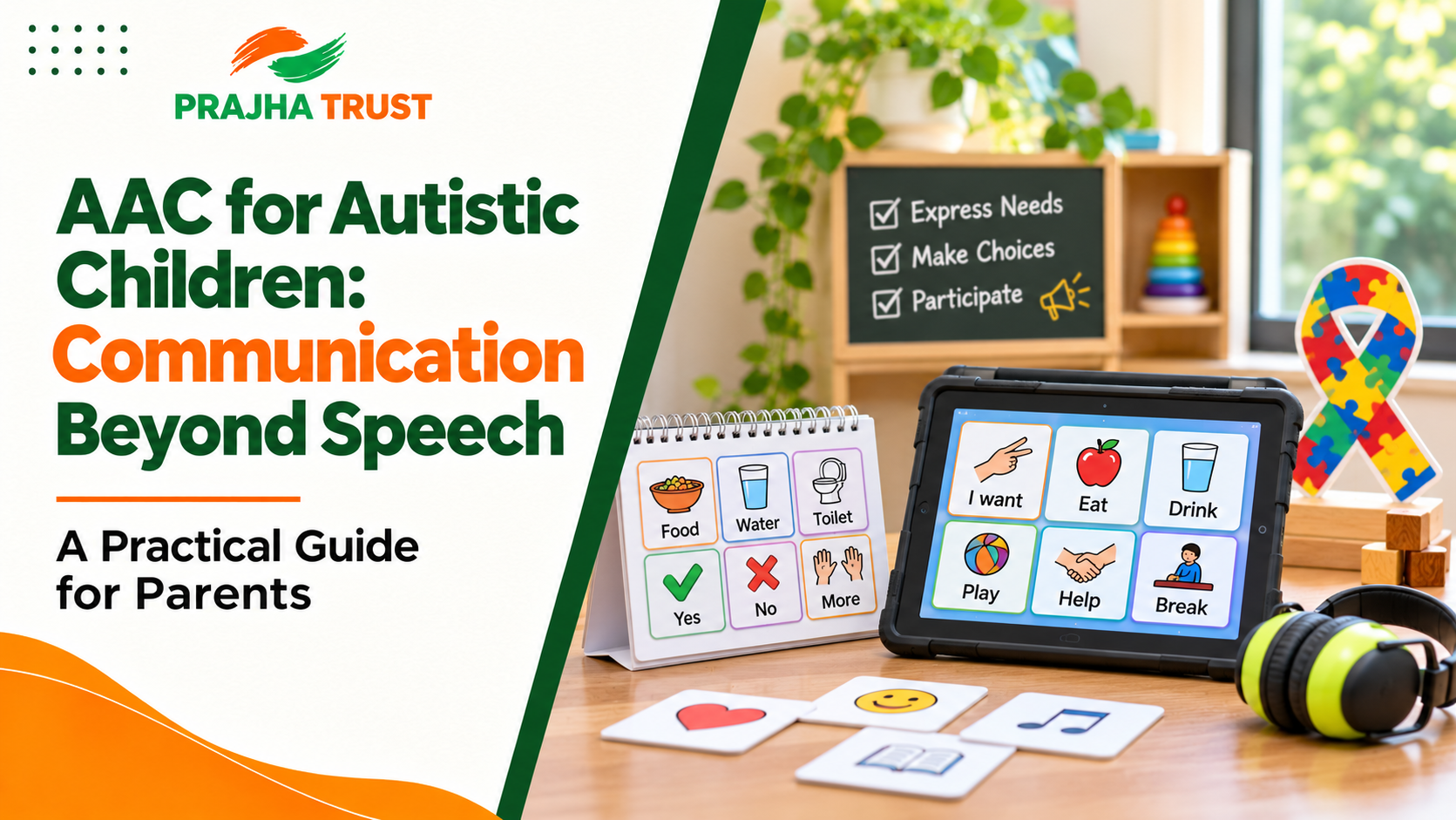
AAC for Autistic Children: A Parent's Guide to Communication Beyond Speech
Every child deserves the opportunity to express their thoughts, feelings, needs and choices. For some autistic children, spoken communication may be difficult, inconsistent or unavailable. However, being unable to speak does not mean a child has nothing to say.
Communication can happen in many ways, including gestures, facial expressions, pictures, written words and assistive technology.
Augmentative and Alternative Communication (AAC) for autistic children offers different ways to communicate, helping them participate in everyday activities, express preferences and connect with the people around them.
For parents, understanding AAC can open new possibilities for supporting their child's communication development.
In this guide, we explain what AAC is, how it works, the different communication tools available and practical ways parents can support communication at home.
What Is AAC for Autistic Children?
Augmentative and Alternative Communication (AAC) refers to methods of communication that supplement or replace spoken language.
AAC can include simple gestures, picture cards, communication boards, written messages and electronic devices that produce speech.
The word augmentative means supporting existing communication, while alternative refers to providing another way to communicate when speech is not available or reliable.
For example, an autistic child who finds it difficult to say "I want water" may point to a picture of a glass of water on a communication board.
Another child may use a tablet-based communication application to express a more detailed message.
AAC is not limited to children who cannot speak. It can also support children who use some spoken language but find verbal communication difficult in certain situations.
The main purpose of AAC is to ensure that children have reliable and meaningful ways to communicate.
Why Is AAC Important for Children With Autism?
Communication differences are common among autistic children, although their abilities and needs vary significantly.
Some children communicate using fluent spoken language. Others may use a combination of spoken words, gestures, pictures or assistive communication devices.
When a child has difficulty communicating their needs, they may experience frustration, misunderstanding or difficulty participating in everyday situations.
AAC can help address these communication barriers by providing additional ways to express thoughts and preferences.
Benefits of AAC Communication
1. Supports meaningful communication
AAC allows children to communicate needs, feelings, interests and preferences using methods that are accessible to them.
2. Encourages greater independence
Children may use AAC to make choices, request assistance, ask questions and participate in daily activities.
3. Supports social participation
Communication tools can help children interact with family members, teachers and classmates.
4. Reduces communication-related frustration
When children have reliable ways to express themselves, some misunderstandings and communication-related difficulties may become easier to manage.
5. Supports language development
AAC provides opportunities to learn and use language. Research indicates that AAC does not prevent spoken-language development and may support it in some children.
Importantly, the value of AAC should not be measured only by whether a child eventually speaks. Effective communication is a meaningful goal in its own right.
Types of AAC Communication Tools for Autistic Children
AAC includes several communication methods, ranging from simple gestures to advanced electronic devices.
These methods are commonly grouped into unaided and aided communication.
1. Unaided AAC: Gestures and Signs
Unaided AAC does not require external tools or devices.
It includes:
Pointing towards objects
Hand gestures
Facial expressions
Body movements
Manual signs
For example, a child may point towards a favourite toy, use a gesture to indicate "more" or shake their head to communicate "no".
These communication attempts should be recognised and respected.
However, not every child can comfortably use gestures or signs, particularly if they experience motor coordination difficulties.
2. Low-Tech AAC: Picture Cards and Communication Boards
Low-tech AAC involves physical materials that support communication without electronic technology.
Examples include picture cards, printed communication boards, books containing symbols and written-word charts.
A communication board may contain pictures representing common needs and activities.
| Picture or symbol | Message |
|---|---|
| Glass of water | I want water |
| Food | I am hungry |
| Favourite toy | I want to play |
| Rest symbol | I need a break |
| Help symbol | Please help me |
Children can point to, touch or otherwise select symbols to communicate.
These tools can be particularly helpful during mealtimes, play and other daily activities.
The symbols and layout should be personalised to the child's preferences and communication abilities.
3. High-Tech AAC: Speech-Generating Devices
High-tech AAC includes electronic communication tools such as tablets, dedicated speech-generating devices and specialised communication applications.
These systems may allow a child to select pictures, words or letters to produce spoken messages.
For example, a child might select symbols to communicate, "I want to go outside."
Some communication applications also allow users to construct detailed sentences and express complex ideas.
High-tech AAC can be valuable for children who need a more extensive communication system.
However, choosing a suitable device requires consideration of the child's needs, preferences, motor abilities, vision and access to professional support.
Does AAC Prevent Autistic Children From Learning to Speak?
One common concern among parents is whether introducing AAC will discourage their child from developing spoken language.
Current evidence does not support the belief that AAC prevents speech development.
In fact, AAC may support spoken communication and language development for some children while also providing an accessible way to communicate.
Children can use AAC alongside spoken words, gestures and other communication methods.
For example, a child may point to a picture while attempting to say the corresponding word.
Another child may continue using AAC as their primary communication method throughout life.
Both are valid communication experiences.
Parents should focus on ensuring that their child can communicate effectively rather than withholding AAC while waiting for speech to develop.
How to Introduce AAC to Your Autistic Child at Home
Introducing AAC works best when communication tools become a natural part of everyday interactions.
Parents can begin with the following strategies.
1. Observe Your Child's Existing Communication Style
Before selecting a communication tool, notice how your child already expresses themselves.
They may use gestures, sounds, facial expressions, movement or familiar objects to communicate.
Understanding these existing methods can help identify appropriate supports.
A speech and language therapist with AAC experience can help assess suitable communication options.
2. Start With Meaningful Communication Opportunities
Introduce AAC through activities that matter to your child.
For example, during snack time, demonstrate how to communicate "more", "finished" or "different".
During play, you can model words such as "go", "stop", "help" and "again".
Communication should extend beyond requesting food or toys. Children also need ways to refuse, comment, ask questions, express emotions and share interests.
3. Model Communication Without Demanding a Response
Modelling means demonstrating how a communication tool works while interacting naturally.
For example, a parent might point to the "play" symbol while saying, "Let's play."
The child can observe how the system is used without being pressured to copy immediately.
Frequent, meaningful modelling can help children become familiar with their AAC systems.
4. Give Your Child Enough Time
Some children need additional time to understand a question, select a symbol or communicate a response.
Avoid rushing, repeatedly prompting or completing every message on their behalf.
Give your child opportunities to communicate independently while providing assistance when requested or needed.
5. Respect Every Communication Attempt
If a child points, gestures, uses a device or communicates through body language, respond meaningfully whenever possible.
Avoid insisting on spoken words before fulfilling a reasonable request.
Communication is about understanding and being understood, not performing a particular form of speech.
7 Everyday Activities to Support AAC Communication
Parents can incorporate AAC into familiar activities without creating a formal teaching environment.
Activity 1: Choosing a Snack
Offer your child opportunities to communicate which snack they prefer using pictures, gestures or their AAC system.
Respect the choice they make.
Activity 2: Reading Picture Books
Read a favourite picture book together and model words such as "look", "funny", "more" or "finished".
Allow your child to comment or participate in their preferred way.
Activity 3: Playing With Toys
During play, model messages such as "go", "stop", "again", "big" and "help".
Follow your child's interests rather than directing every activity.
Activity 4: Selecting Clothes
Use pictures, objects or communication devices to help your child choose between comfortable clothing options.
This encourages participation in everyday decisions.
Activity 5: Communicating Feelings
Provide accessible ways to express emotions and physical needs, such as "happy", "worried", "tired", "hurt" and "need a break".
Avoid assuming that a child is experiencing a particular emotion without checking their response.
Activity 6: Family Conversations
Include your child in family discussions by making their communication system available.
Provide sufficient time for them to contribute, ask questions or express opinions.
Activity 7: Outdoor Activities
AAC can be used during walks, park visits, shopping and family outings.
Model relevant words such as "outside", "home", "stop", "look" and "more".
This reinforces the idea that communication is useful everywhere, not only during therapy or structured activities.
Common AAC Mistakes Parents Should Avoid
Using AAC Only During Therapy Sessions
AAC should be available throughout everyday life, including at home, school and in the community.
Restricting communication tools to scheduled sessions can limit opportunities for spontaneous communication.
Requiring Speech Before Accepting AAC
If a child communicates successfully using AAC, their message should be acknowledged.
Withholding something they need until they speak may create unnecessary distress.
Limiting AAC to Basic Requests
Children need more than a way to ask for food or water.
AAC should also support expressing opinions, rejecting activities, asking questions, telling stories and building relationships.
Changing Communication Systems Too Frequently
Children may benefit from consistent access to familiar vocabulary and layouts.
Changes to communication systems should be considered carefully, ideally with professional guidance and the child's involvement.
Assuming AAC Is Only for Non-Speaking Children
AAC can also support children who speak but sometimes find spoken communication difficult or unreliable.
The decision should depend on individual communication needs.
When Should Parents Consider Professional AAC Support?
Parents may benefit from consulting a qualified speech and language therapist when their child:
Has difficulty expressing everyday needs.
Uses limited or unreliable spoken communication.
Experiences frequent communication breakdowns.
Needs additional ways to participate in school or family activities.
May benefit from a personalised communication board or speech-generating device.
A professional AAC assessment considers a child's communication abilities, interests, physical access needs and everyday environments.
Parents, teachers and caregivers should also be involved in understanding how to support consistent communication.
There is no requirement for a child to reach a particular age, cognitive level or speech milestone before AAC can be considered.
How Can Early Intervention Support Communication Development?
Early intervention focuses on understanding developmental needs and providing appropriate support during a child's early years.
For autistic children with communication differences, this may include speech and language support, AAC assessment, parent guidance and opportunities to develop functional communication skills.
An individualised approach is important because every child's communication profile is different.
Some children may benefit from picture-based communication, while others may require electronic communication devices or a combination of methods.
Professionals can work with families to identify meaningful goals and support communication across everyday environments.
Parents play a valuable role by recognising communication attempts, modelling communication and helping children access their preferred methods.
Frequently Asked Questions About AAC for Autism
1. What does AAC mean in autism?
AAC stands for Augmentative and Alternative Communication. It includes communication methods such as gestures, picture boards, written words and speech-generating devices that support or replace spoken communication.
2. Can an autistic child use AAC even if they can speak?
Yes. AAC can support children who use spoken language but experience difficulties communicating in certain situations. Speech and AAC can be used together.
3. At what age can a child start using AAC?
AAC can be considered during early childhood, including for very young children. There is no minimum age or specific developmental prerequisite for introducing appropriate AAC support.
4. Will AAC delay speech development?
Research does not indicate that AAC delays speech development. Some children may develop additional spoken-language skills while using AAC, although individual outcomes vary.
5. Can parents create an AAC communication board at home?
Parents can create simple picture boards using familiar images and symbols. However, a qualified speech and language therapist can help determine whether the system provides sufficient vocabulary and suits the child's communication needs.
6. Is AAC useful only for autistic children?
No. AAC may support people with various communication needs, including some individuals with cerebral palsy, developmental disabilities, speech disorders and acquired neurological conditions.
Conclusion: Every Child Deserves a Voice
Communication is much more than spoken words. It is the ability to share experiences, express preferences, ask questions, communicate needs and build meaningful relationships.
For autistic children who experience communication differences, AAC can provide valuable opportunities for participation, independence and connection.
Whether a child uses gestures, picture cards or speech-generating technology, their communication deserves to be recognised, respected and supported.
Parents can make a meaningful difference by creating communication opportunities at home, responding patiently and seeking suitable professional guidance.
At Prajha Trust, our focus is on helping children and families access developmental support, communication guidance and inclusive opportunities that respect each child's individual needs.
Explore Early Intervention and Communication Support at Prajha Trust
If you are concerned about your child's communication development or would like to understand suitable early support options, explore Prajha Trust's Early Intervention for Autism in Chennai.
Learn about child-focused developmental initiatives, communication and language support, and parent guidance designed to help families take informed steps.
Support your child's communication journey with understanding, encouragement and appropriate guidance from Prajha Trust.
Prajha Trust Clinical Guidance & Support
Every child’s developmental milestones are unique. If you have questions regarding speech articulation, occupational motor therapy, or autism behavioral support, our dedicated clinical specialists are here to guide your family.
About Prajha Trust
Prajha Trust is a registered non-profit organization in Tamil Nadu dedicated to autism spectrum care, early intervention, occupational therapy, and fostering an inclusive society.