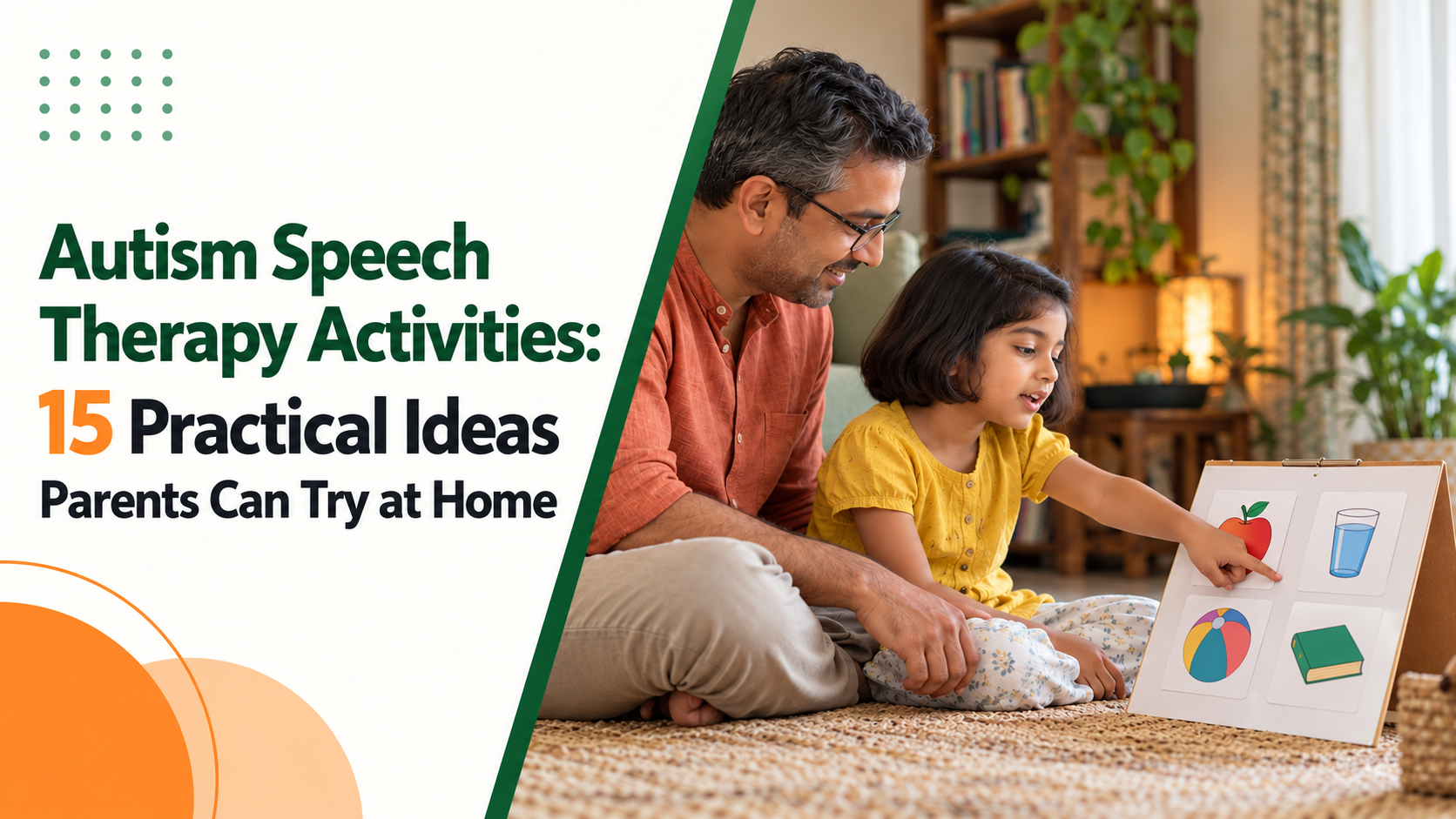
Autism Speech Therapy Activities: 15 Practical Ideas Parents Can Try at Home
When parents look for autism speech therapy activities, they are often searching for one thing: practical ways to help their child communicate more successfully at home.
But communication development is not only about teaching a child to say more words.
An autistic child may communicate through spoken words, sounds, gestures, facial expressions, pictures, signs or an Augmentative and Alternative Communication (AAC) system.
For one child, progress might mean learning a new word.
For another, it might mean pointing to a picture to request water.
For another, it could mean learning to say or communicate “no,” “help,” “finished” or “I need a break.”
All of these can be meaningful communication.
This is why useful speech and language activities should focus on functional communication, rather than simply asking children to repeat words.
In this guide, we will look at practical speech therapy activities for autism that parents can incorporate into play, meals, books and everyday routines.
These activities are not a replacement for individualized assessment or therapy from a qualified speech-language professional. Instead, they can help parents create more natural opportunities for communication throughout the day.
Why Communication Activities at Home Matter
A child does not communicate only during a therapy session.
Communication happens when they want breakfast.
When they cannot open a toy.
When they want someone to continue playing.
When they see something interesting.
When they do not want an activity.
When they need help.
Everyday life therefore creates hundreds of opportunities for communication.
Professional speech-language guidance recognizes that caregiver-supported strategies can be incorporated into natural activities and daily routines. The objective is not to turn parents into therapists but to help communication skills become useful beyond a therapy setting.
A word learned during a structured session becomes much more meaningful when the child can use it spontaneously at home, school or in the community.
Before Starting: Communication Is More Than Speech
This distinction is extremely important.
Speech is one way we communicate.
Communication is much broader.
An autistic child may communicate using:
spoken words;
gestures;
pointing;
facial expressions;
pictures;
signs;
written words;
communication boards; or
AAC devices.
Some autistic children speak fluently but have difficulty with conversational or social communication.
Others use only a few spoken words.
Some communicate primarily through AAC.
The aim should therefore not automatically be:
“How can I make my child talk?”
A better starting point is:
“How can I help my child communicate what they need, think, feel or want?”
That shift makes home activities much more meaningful.
15 Autism Speech Therapy Activities to Try at Home
The following activities can be adapted according to your child's age, communication level, interests and recommendations from their speech-language professional.
1. Offer Choices During Everyday Activities
Instead of automatically giving your child something, offer two appropriate choices.
For example:
“Banana or apple?”
Show both items while asking.
Your child might respond by:
saying the word;
pointing;
reaching;
looking;
signing;
selecting a picture;
using AAC.
The important part is that their communication produces a meaningful result.
If the child chooses the banana, give them the banana.
This teaches an important concept:
Communication works.
You can create choices throughout the day:
“Red shirt or blue shirt?”
“Car or ball?”
“Water or milk?”
“Book or music?”
Start with choices the child can clearly understand.
2. Create Opportunities to Request
Parents naturally anticipate their child's needs.
You know which cup they want.
You know which cartoon they are asking for.
You know which toy they are reaching toward.
Sometimes, however, immediately providing everything removes an opportunity for the child to communicate.
Instead, create a brief and supportive pause.
For example, put a favourite toy somewhere visible but not immediately accessible.
Wait.
Your child might look at you, point, vocalize, use a word or communicate through AAC.
Respond to the attempt.
Do not turn this into a frustrating test.
The goal is to create an opportunity for communication, not to withhold something until the child produces perfect speech.
3. Use Simple Language During Daily Routines
Adults sometimes use more language than a child can easily process.
Imagine a parent saying:
“Come on, we're already late, go and get your shoes because we need to leave now.”
For some children, shorter language may be clearer:
“Get shoes.”
Then:
“Shoes on.”
Then:
“Let's go.”
The appropriate level depends on the child.
The idea is to make language understandable and connected to what is happening.
4. Narrate What Your Child Is Doing
You do not always need to ask questions.
Sometimes simply describe what your child is doing.
If they are playing with a car:
“Car.”
“Red car.”
“Car goes fast.”
“Up.”
“Down.”
“Crash!”
This connects language with the child's current attention.
It can feel much more natural than repeatedly asking:
“What colour is the car?”
“What is this?”
“What does the car do?”
Constant questioning can make interaction feel like a test.
Commenting allows language to become part of shared play.
5. Expand What Your Child Communicates
If your child communicates one word, you can model a slightly longer version without forcing repetition.
Child:
“Car.”
Parent:
“Red car.”
Child:
“Juice.”
Parent:
“Want juice.”
Child:
“Dog running.”
Parent:
“The dog is running fast.”
The idea is to model language just beyond what the child is currently using.
You do not need to say:
“Now repeat after me.”
Natural modelling can provide the child with useful language examples.
6. Use Favourite Toys for Communication
The best speech activity is not always a special flashcard set.
Sometimes it is the toy your child already loves.
Suppose your child loves bubbles.
You can create opportunities for words or communication such as:
bubble;
more;
open;
pop;
big;
again;
finished.
Pause before blowing again.
If your child communicates “more” using speech, gesture, sign, picture or AAC, respond naturally by blowing more bubbles.
Motivation can make communication opportunities much stronger.
7. Read Books Together
Shared reading can support communication and language development when it is interactive rather than simply reading every word from beginning to end.
Choose books with:
clear pictures;
simple stories;
repetition;
topics your child enjoys.
While reading, you can:
point to pictures;
label objects;
make simple comments;
imitate sounds;
pause during predictable phrases;
connect pictures to real experiences.
If there is a dog in the story:
“Dog!”
“Big dog.”
“Dog running.”
You might connect it to your child's experience:
“We saw a dog yesterday.”
The aim is interaction, not completing the book.
If your child wants to spend several minutes looking at one page, that can still become a communication opportunity.
8. Sing Familiar Songs and Pause
Songs with predictable patterns can create natural opportunities for participation.
Choose a familiar song.
Sing most of a familiar line and pause before an expected part.
For example:
“Twinkle, twinkle, little…”
Then wait briefly.
The child might:
say the next word;
make a sound;
gesture;
look toward you;
use AAC.
Respond positively to the communication attempt.
Avoid turning every pause into pressure to perform.
The activity should remain enjoyable.
9. Use Action Words During Play
Communication development is not only about naming objects.
Children also need words for actions.
During play, model words such as:
go;
stop;
open;
close;
jump;
push;
pull;
eat;
drink;
run;
sleep.
If playing with a toy car:
“Go!”
Push the car.
“Stop!”
Stop it.
This makes the meaning of the word visible through an action.
10. Practice “Help”
Being able to request assistance is an important functional communication skill.
Use everyday situations where help is naturally needed.
For example, your child may have difficulty opening a container.
Model:
“Help.”
or
“Help me.”
If the child communicates a request for assistance through their established communication method, respond.
This skill can become important at home, school and in the wider community.
11. Practice “More,” “Finished” and “Stop”
Functional words can sometimes be more useful than memorizing long vocabulary lists.
Three particularly useful concepts are:
More
Finished
Stop
During snack time:
“More?”
During play:
“More bubbles?”
At the end:
“Finished.”
If the child wants an activity to stop, help them communicate that appropriately.
Teaching children how to refuse or end something is also part of communication.
Communication is not only about requesting things adults want children to request.
12. Use Family Photos for Conversation
Photos can make language personally meaningful.
Look at pictures of:
parents;
siblings;
grandparents;
familiar places;
school activities;
birthdays;
outings.
You can model simple language:
“Appa.”
“Amma cooking.”
“Grandma smiling.”
“We went to the park.”
For children using longer language, photos can support storytelling:
“What happened here?”
“Who was with us?”
“What did we do next?”
Adjust the activity according to the child's communication level rather than expecting the same response from every child.
13. Play Turn-Taking Games
Communication involves interaction with another person.
Simple turn-taking activities can help children practise the rhythm of interaction.
Try:
rolling a ball back and forth;
building a block tower together;
taking turns adding puzzle pieces;
simple board games appropriate for the child's level.
Use simple language:
“My turn.”
“Your turn.”
“Again.”
“Ready?”
The goal is not perfect social behaviour.
It is creating enjoyable opportunities for shared interaction.
14. Talk During Household Routines
You do not need a separate therapy table for every communication activity.
Use daily routines.
While dressing:
“Shirt on.”
“Blue shirt.”
“Socks.”
“Shoes.”
During meals:
“Rice.”
“More?”
“Water.”
“Hot.”
“Finished?”
During bath time:
“Water.”
“Wash.”
“Soap.”
“Dry.”
While leaving home:
“Bag.”
“Shoes.”
“Door open.”
“Let's go.”
Repeating useful language within predictable routines helps connect communication to real experiences.
15. Use Pretend Play When Appropriate
Some children enjoy pretend play, while others may prefer different kinds of play.
If your child enjoys it, use simple scenarios such as:
feeding a doll;
making toy animals sleep;
driving cars to a pretend shop;
cooking with toy food;
taking a toy animal to a pretend doctor.
Model language naturally:
“Baby hungry.”
“Eat.”
“Baby sleeping.”
“Night-night.”
“Car going home.”
Follow the child's interests instead of forcing a particular style of play.
What About Eye Contact?
Parents sometimes encounter advice telling them that speech activities should make an autistic child maintain eye contact.
Communication does not require constant eye contact.
Some autistic people find direct eye contact uncomfortable or distracting.
A child may be listening even when they are not looking directly at your eyes.
Instead of repeatedly saying:
“Look at me.”
focus on whether the child is:
understanding;
responding;
communicating;
participating.
The aim should be meaningful interaction, not making communication appear neurotypical.
Should Parents Ask Their Child to Repeat Words?
Occasional imitation can be useful within professionally recommended activities, but constant demands to “say this” or “repeat after me” can turn communication into a performance.
Imagine wanting water and being told:
“Say water.”
The child tries to communicate.
“Say it properly.”
The child becomes frustrated.
Communication has now become a test rather than a way to get a need met.
A more supportive approach often involves modelling the word and responding to an appropriate communication attempt.
For example:
Child points toward water.
Parent models:
“Water.”
Then provides the water.
The exact strategy should be adapted to the child's communication goals.
What If My Autistic Child Does Not Speak?
Lack of spoken speech does not mean lack of communication or understanding.
Some autistic children may use Augmentative and Alternative Communication (AAC).
AAC can include:
gestures;
picture communication;
communication boards;
signs;
speech-generating devices;
communication applications.
AAC is not simply a “last option” for communication.
For some children, it can provide an important way to express needs, choices and ideas.
Research and professional guidance support multimodal communication and the involvement of families in communication strategies when appropriate.
If your child has limited spoken communication, a qualified speech-language professional can assess which communication approaches may be suitable.
How Long Should Parents Practice Speech Activities?
There is no universal number of minutes that works for every autistic child.
Communication opportunities can be incorporated naturally throughout the day.
Five minutes of enjoyable interaction during play may sometimes be more productive than forcing a child through a long activity they find stressful.
Think:
little and often.
Breakfast can contain communication.
Getting dressed can contain communication.
Playing can contain communication.
Going to the park can contain communication.
Bath time can contain communication.
This helps skills become part of everyday life instead of something that happens only during “therapy time.”
Common Mistakes to Avoid
Parents naturally want to help, but more practice is not always better practice.
Try to avoid:
asking question after question;
demanding constant repetition;
forcing eye contact;
comparing the child with siblings or peers;
ignoring gestures or AAC because you want spoken words;
correcting every communication attempt;
turning every play activity into therapy;
continuing when the child is clearly distressed;
choosing activities only because they are labelled “for autism.”
The goal is communication.
Not perfection.
How Parents Can Track Communication Progress
Progress may be easier to recognize when goals are specific.
Instead of:
“I want my child to talk more.”
a goal might be:
“My child will independently request help during familiar activities.”
Or:
“My child will choose between two snacks using their established communication method.”
Or:
“My child will participate in three turns of a preferred interaction.”
These goals are more observable.
Parents can note:
what happened;
how the child communicated;
what support was required;
whether the child communicated independently.
Share useful observations with the child's speech-language professional.
When Should Parents Seek Professional Speech and Language Support?
Consider professional guidance if you have concerns about your child's ability to understand or use communication effectively.
This might include difficulty with:
communicating basic needs;
understanding language;
developing functional communication;
participating in interactions;
using spoken language;
communicating across environments;
eating or swallowing concerns that require appropriate professional assessment.
Speech-language professionals can assess the child's individual communication profile and help establish appropriate goals.
Parents who want a broader explanation of professional intervention can read Prajha Trust's existing guide on Speech Therapy for Autism: Benefits, Techniques, Activities & Parent's Guide.
That article explains speech therapy more broadly, while this guide focuses specifically on practical communication opportunities families can use at home.
Speech Therapy, Occupational Therapy and Special Education Can Work Together
Children do not experience communication in isolation.
A sensory difficulty might affect participation.
A motor difficulty might affect the use of certain communication tools.
Learning needs might influence how instructions should be presented.
This is why some children benefit from coordinated support across disciplines.
Depending on the child's individual needs, this may involve:
speech and language support;
occupational therapy;
special education;
behavioural or developmental support;
social skill development;
parent training.
The objective should be shared:
helping the child participate more successfully in everyday life.
How Prajha Trust Supports Communication and Development
At Prajha Trust, support for autistic children extends beyond isolated therapy sessions.
Its Integrated Autism Academy brings together speech therapy, occupational therapy, special education, behaviour management, applied daily living and social skill development within a structured support environment.
Prajha Trust also recognizes that parents and caregivers are an important part of a child's development.
Through its parent-support approach, families can gain practical understanding of how developmental goals can connect with everyday life.
This matters because communication does not end when a therapy session finishes.
A child needs opportunities to communicate:
at home,
at school,
during play,
with family,
and eventually within the wider community.
The aim is not simply to produce more words.
It is to build communication that helps the child express needs, make choices, participate and develop greater independence.
Families looking for structured autism support in Chennai can explore the Prajha Trust Autism Academy to learn more about its integrated education, therapy and family-support programs.
Frequently Asked Questions
What are good autism speech therapy activities at home?
Useful activities include offering choices, shared reading, singing familiar songs, modelling simple language during routines, turn-taking games, requesting help and using favourite toys to create communication opportunities. Activities should match the child's individual communication abilities and interests.
How can I encourage my autistic child to communicate?
Create meaningful reasons to communicate, respond to communication attempts, model useful language and recognize communication through speech, gestures, pictures, signs or AAC where appropriate. Avoid pressuring the child to produce perfect spoken words before responding to their needs.
Can parents do speech therapy activities at home?
Parents can support professionally recommended communication goals through play and everyday routines. This does not replace individualized assessment or intervention from a qualified speech-language professional when these services are needed.
Should I make my autistic child repeat words?
Repeatedly forcing a child to imitate words is not the only way to support communication. Modelling useful language during meaningful situations and responding to communication attempts can create more natural opportunities for language development. Follow individualized recommendations from the child's speech-language professional.
What if my autistic child communicates without speaking?
Communication can include gestures, signs, pictures and AAC systems as well as spoken language. A speech-language professional can assess communication needs and recommend appropriate approaches.
Can AAC stop an autistic child from learning to speak?
AAC is used to support functional communication for people who need it. Decisions about AAC should be individualized and made with appropriate professional assessment rather than withholding communication support out of fear that it will prevent speech.
How often should parents practise communication activities?
There is no single schedule suitable for every child. Communication strategies can often be incorporated into normal routines throughout the day. Professional recommendations should guide structured practice when a child is receiving speech-language therapy.
Prajha Trust Clinical Guidance & Support
Every child’s developmental milestones are unique. If you have questions regarding speech articulation, occupational motor therapy, or autism behavioral support, our dedicated clinical specialists are here to guide your family.
About Prajha Trust
Prajha Trust is a registered non-profit organization in Tamil Nadu dedicated to autism spectrum care, early intervention, occupational therapy, and fostering an inclusive society.