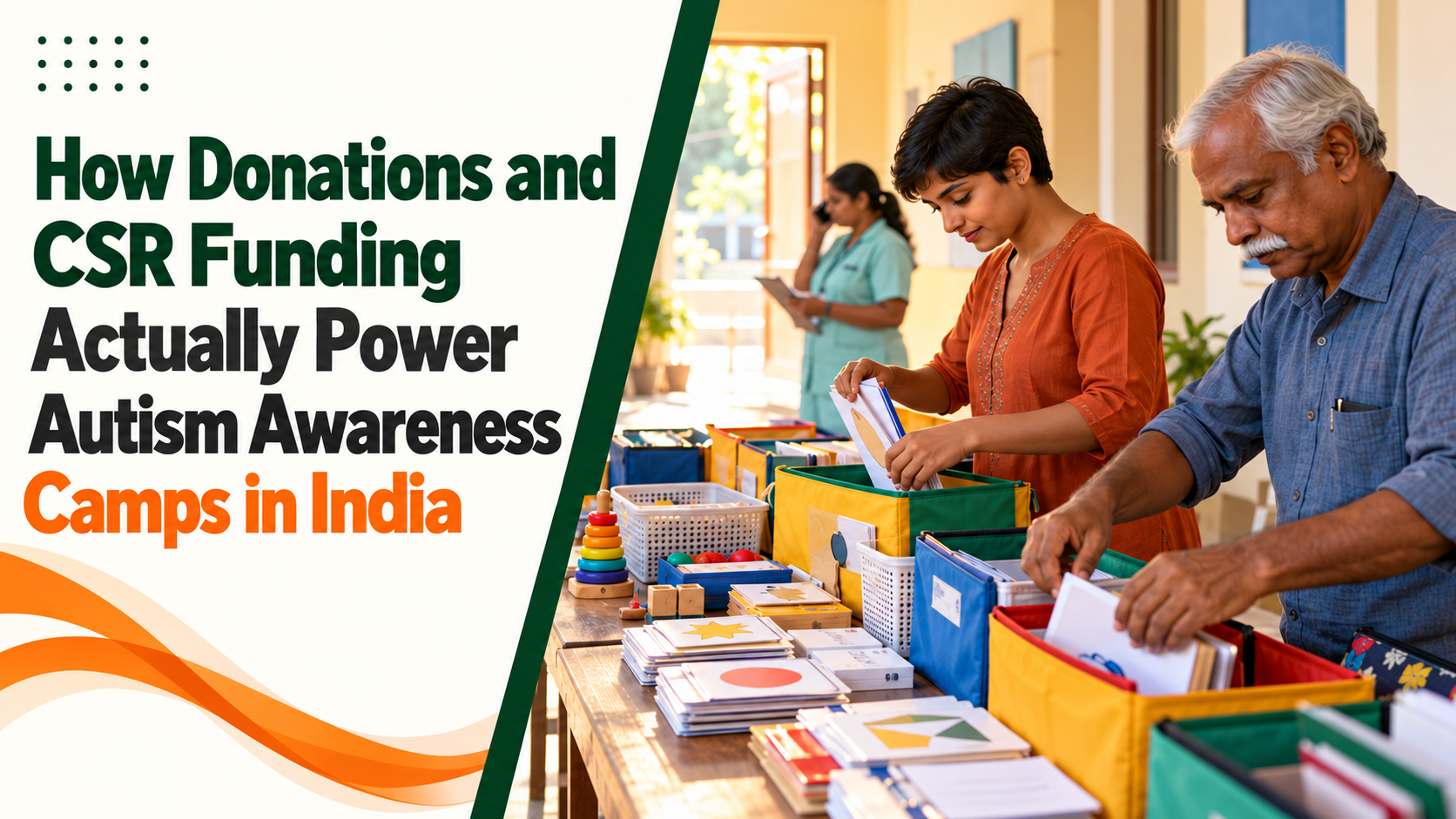
Quick answer: An autism awareness camp is a one-day, structured screening and referral event where a clinical team assesses children for developmental delays and connects flagged cases to therapy or diagnosis. In India, these camps are funded almost entirely through individual donations and corporate CSR budgets, because government screening infrastructure covers only a small fraction of the population that needs it. A donation typically funds one of three things: pre-camp outreach, the clinical team's fees on the day, or post-camp follow-up and referral. Companies can fund camps directly as a Schedule VII–compliant CSR activity under the Companies Act, 2013.
That's the summary. Here's the detail, because the summary alone won't tell you whether this is worth your money or your CSR budget line.
The Scale of the Problem, in Actual Numbers
India doesn't have a strong national picture of autism prevalence, and that gap is itself part of the story. For decades, the only official figure came from the 2011 census, which recorded neurodevelopmental disability at roughly 1.3% of the population — a number researchers have since called far too low. The first large, rigorous study to challenge that number was conducted by the INCLEN Trust and published in PLOS Medicine. It found that about 1 in 100 children in India under age 10 may have autism, and nearly 1 in 8 has at least one neurodevelopmental condition — an estimate roughly ten times higher than the 1.3% figure reported in the 2011 census. A separate 2024 review put the number of Indian children affected by autism spectrum disorder (ASD) between 1.8 and 2 million, with roughly 1 in 65 children aged two to nine affected. The Transmitter + 2 Prevalence isn't evenly spread either. The INCLEN data found autism rates ranging from 0.4% in largely urban North Goa to 1.8% in rural Palwal, Haryana — a five-fold difference that has more to do with access to screening than with any real biological difference between regions. And access is the real bottleneck: standardized autism screening tools are currently available in fewer than 5 of India's 22 official languages, which means a family's chance of getting a proper screening still depends heavily on which language they speak and how close they live to a developmental pediatrician. The TransmitterSparshmindinnovations Put plainly: most autistic children in India who need to be screened simply aren't being screened. That's not a funding gap that sorts itself out through hospital infrastructure alone — it's why field camps exist, and why they're staffed and paid for through donations and CSR money rather than government health budgets.What Actually Happens Inside a Camp
A Prajha Trust autism awareness camp is not an awareness stall with pamphlets. It's a structured clinical event with three stages, run in one location on one day:- Screening.A developmental pediatrician, psychologist, or trained therapist runs a short, standardized assessment covering speech, motor skills, social response, and sensorybehaviour. This is the step that catches delays a parent may have noticed but not known how to name.
- Guidance.Every family gets a plain-language conversation about what the screening found — not a diagnosis handed over cold, but a clear explanation of what to watch for and what to do next. This step matters more than it sounds:a huge number of missed cases in India aren't missed because no one noticed, they're missed because no one explained what the signs meant.
- Referral.Flagged children are connected onward — to a hospital for formal diagnosis, tospeech or occupational therapy, or to longer-term programs. Referral without follow-up is where most awareness efforts quietly fail, which is why the next section matters.
Where a Donation Actually Goes
This is usually the part NGO sites skip. Here's the honest, itemized version of what a camp-linked donation funds, broken into three phases: Before the camp- Booking a venue — typically a school, community hall, or government hospital OPD space
- Printing screening forms and parent-education material in Tamil and English
- Local outreach — going through school staff, anganwadi workers, or door-to-door visits so families actually know the camp is happening and don't dismiss it as irrelevant
- Paying the developmental pediatrician, psychologist, and therapists running the screenings — this is the single largest line item; most camps run on a small paid core clinical team, not volunteers
- Basic assessment materials for speech, motor, and sensory checks
- Transport support for families travelling in from outside the city, and refreshments for a day that often runs four to five hours
- Follow-up calls to every referred family, so a referral doesn't just sit unused on a form
- Enrolling children who need it into longer-term support — this is where a single camp connects into Prajha Trust's Autism Academy for structured special education, or Community Living for residential support
Why This Is a Serious CSR Category, Not Just a Charitable One
If you're evaluating CSR options rather than donating personally, the numbers behind India's CSR mandate are worth knowing, because they explain why autism camps fit cleanly into a compliance framework rather than sitting in a vague "goodwill" bucket. Under Section 135 of the Companies Act, 2013, companies above certain thresholds — net worth of ₹500 crore, turnover of ₹1,000 crore, or net profit of ₹5 crore — are legally required to spend at least 2% of their average net profit over the preceding three years on CSR activities. Schedule VII of the Act lists the categories that qualify, and healthcare and education sit right at the top of that list — Schedule VII explicitly includes promoting health care, including preventive health care, and promoting education, including special education for the differently abled, which is precisely what an autism screening camp does. Vajiram & RaviCsradvise The money involved is significant. Across the National CSR portal, 27,188 companies funded 59,633 CSR projects in FY 2023-24, spending around ₹34,908.75 crore across 14 development sectors. Looking specifically at listed companies, CSR spending rose 16% to ₹17,967 crore in FY24, with education receiving the largest share at ₹1,104 crore and healthcare close behind at ₹720 crore. Special education for children with developmental disabilities sits at the intersection of both categories — which is exactly why autism camps are one of the more straightforward CSR line items to justify and report on, compared to broader "community welfare" spending that's harder to measure. CleartaxVajiram & Ravi For companies scoping this financial year's CSR budget, Prajha Trust's CSR page lists current registration certifications (80G, 12A, CSR-1) and the specific programs open for sponsorship.Who Should Fund a Camp: A Quick Comparison
| Individual Donor | Corporate CSR Partner | School / Hospital Host | |
| What you fund | A specific line item — screening tools, one therapist's session, transport for a family | A full camp in a chosen city or district, as a standalone Schedule VII project | No funding required — you provide the venue |
| Documentation | 80G tax receipt, issued immediately | CSR-1 compliant documentation, project report for Form CSR-2 filing | Partnership letter, camp report for your own records |
| Typical commitment | One-time or monthly | Quarterly or annual sponsorship of one location | One-day venue access |
| Where to start | Donate page | CSR page | Contact Us |
What Happens to a Child After the Camp
This is the part that determines whether a camp actually changes an outcome or just produces a paper referral. Children flagged during screening at a Prajha Trust camp are followed up by phone within weeks, not months. Depending on what the screening found, a child is directed toward:- Formal diagnostic evaluation at a partner hospital, for families who need a confirmed diagnosis before accessing government disability benefits or school accommodations
- The Autism Academy, for structured special education and skill-building for children already diagnosed
- Community Living support, for older individuals who need longer-term residential or vocational care
Frequently Asked Questions
Is a donation toward an autism awareness camp tax-deductible in India? Yes. Prajha Trust holds 80G registration, so contributions toward camps qualify for a tax deduction under the Income Tax Act, and receipts are issued immediately. Full details are on the Donate page. Can a company sponsor one specific camp instead of making a general CSR donation? Yes. A company can fund a single camp in a chosen district as a standalone, reportable CSR project rather than a general contribution — this is discussed directly on the CSR page. How common is autism in India, and why does it feel under-reported? Recent research estimates about 1 in 100 children under 10 in India may have autism, roughly ten times higher than the outdated 2011 census figure. It appears under-reported mainly because standardized screening tools exist in fewer than 5 of India's 22 official languages, and clinical infrastructure for developmental screening remains thin outside major cities. What's the difference between this article and Prajha Trust's main Autism Awareness Camps page? The Autism Awareness Camps in India page covers what camps are, where they're held, and how to organize one. This article specifically covers where donation and CSR money goes and why it qualifies as a compliant CSR category. What happens if a child is flagged at a camp but the family can't afford follow-up care? Flagged children are connected to Prajha Trust's own follow-up pathway — including the Autism Academy and Community Living programs — specifically so a lack of family resources doesn't end the process at the referral stage.The Actual Ask
Every number in this article — 1 in 100 children, ₹720 crore in CSR healthcare spending, five languages out of twenty-two — represents the same underlying problem: capacity to screen and support exists, but it doesn't reach most families without deliberate funding. A camp is where that gap gets closed, one clinical team, one venue, and one follow-up call at a time. If you're an individual, fund a specific part of the next camp. If you're evaluating CSR options for this financial year, talk to us about sponsoring a camp as a Schedule VII healthcare or education project.Prajha Trust Clinical Guidance & Support
Every child’s developmental milestones are unique. If you have questions regarding speech articulation, occupational motor therapy, or autism behavioral support, our dedicated clinical specialists are here to guide your family.
About Prajha Trust
Prajha Trust is a registered non-profit organization in Tamil Nadu dedicated to autism spectrum care, early intervention, occupational therapy, and fostering an inclusive society.