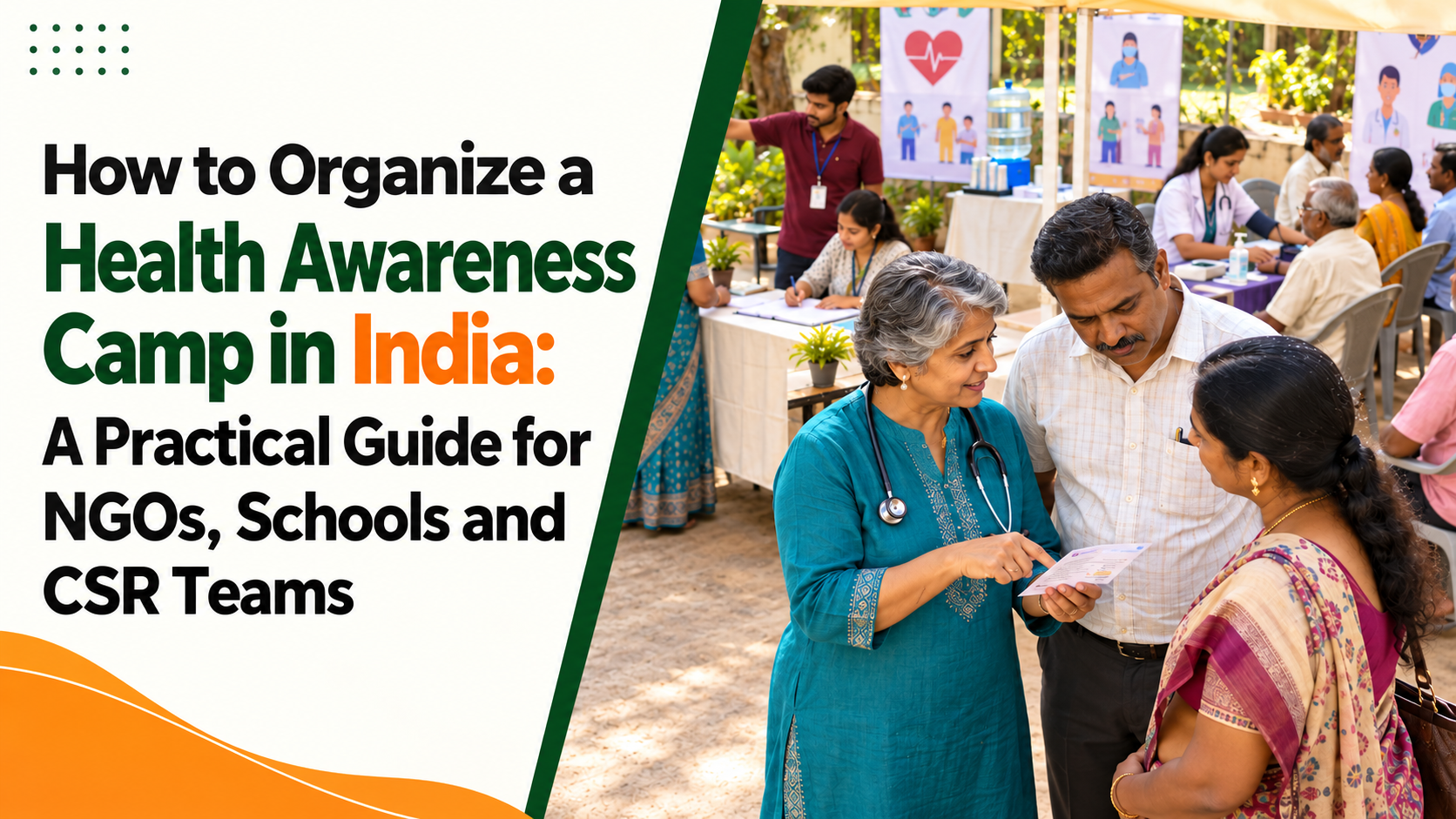
How to Organize a Health Awareness Camp in India: A Practical Guide for NGOs, Schools and CSR Teams
Organizing a health awareness camp may sound straightforward: choose a location, bring in healthcare professionals, invite the community and conduct screenings.
But a successful health awareness camp requires much more than arranging a one-day event.
If people attend a camp, receive information and leave without knowing what to do next, the activity may create awareness but limited long-term change. If screening identifies a concern but families cannot access an assessment or follow-up service, another important opportunity is lost.
The most effective awareness camps create a pathway:
Community need → Awareness → Screening → Professional guidance → Referral → Follow-up
This approach is especially important when awareness programs involve children, developmental delays, autism, learning disabilities or other conditions where early identification may help families access appropriate support sooner.
India's Rashtriya Bal Swasthya Karyakram follows a similar principle at a much larger public-health level. The programme combines child-health screening with early identification, referral, intervention and follow-up rather than treating screening as the final step.
For NGOs, schools, hospitals, community organizations and CSR teams, this provides an important lesson:
The success of a health camp should be measured by what happens after the camp, not merely by how many people attended it.
This guide explains how to plan a health awareness camp that is accessible, responsible and capable of creating measurable community impact.
What Is a Health Awareness Camp?
A health awareness camp is an organized community outreach activity designed to improve people's understanding of a health issue and connect them with appropriate information, screening, professional guidance or healthcare services.
Different camps can serve very different purposes.
A general community camp may focus on blood pressure, diabetes, nutrition or preventive healthcare. A women's health program may focus on screening and reproductive health. A school program may cover developmental milestones, learning difficulties, speech and communication concerns or emotional wellbeing.
An autism or developmental-awareness camp may help parents and teachers understand developmental differences, recognize when professional guidance could be useful and learn where appropriate assessment and support are available.
The important point is that awareness and diagnosis are not the same thing.
An awareness event should educate communities and guide people toward qualified professionals rather than encouraging families to diagnose themselves or their children based on a checklist.
Prajha Trust's existing autism-awareness initiatives follow this community-focused approach by combining awareness, screening, parent support, training and access to further guidance.
Internal link: Autism Awareness Camps in India
Why Health Awareness Camps Matter in India
India has an enormous and diverse population, and access to health information and specialist services differs significantly between communities.
For many families, particularly those outside major healthcare networks, the biggest initial problem may not be unwillingness to seek help. They may simply not know:
- whether what they are observing requires professional attention,
- which professional they should approach,
- what services are available,
- what the next step should be,
- or how they can access ongoing support.
Community outreach can reduce this gap.
The World Health Organization describes community engagement as developing relationships that allow stakeholders to work together on health-related concerns and improve wellbeing. It notes that meaningful community engagement can influence behaviour, programmes, environments and health practices.
That means an awareness camp should not merely deliver information to a community.
It should work with the community.
Step 1: Start With the Community Need, Not the Event
One of the biggest mistakes when organizing an awareness camp is deciding the activity before understanding the problem.
For example:
“We have CSR funding, so let's conduct a health camp.”
That is an activity-first approach.
A more useful starting point is:
“What problem in this community are we trying to reduce?”
Suppose a school reports that teachers are seeing children with speech, attention or learning difficulties but parents do not know where to seek guidance.
In that situation, a generic medical check-up may not solve the underlying problem.
A developmental-awareness program involving teachers, parents and relevant professionals may be more appropriate.
Likewise, if a community has good awareness but poor access to assessment, money may be better invested in screening, referral and follow-up rather than another introductory seminar.
Questions to answer before planning
| Question | Why it matters |
|---|---|
| Who is the target community? | Determines language, venue and services |
| What health problem is being addressed? | Prevents overly generic camps |
| What information does the community already have? | Avoids repeating what people know |
| What service is difficult to access? | Helps define the intervention |
| Who needs to participate? | Identifies professionals and partners |
| What happens after the camp? | Creates continuity of care |
This first stage determines almost everything that follows.
Step 2: Define One Clear Objective
Trying to cover every possible health concern in one event often reduces the usefulness of the program.
Instead, define one primary objective.
For example:
General health camp:
Identify common health risks and guide residents toward preventive healthcare.
School developmental-awareness program:
Help parents and teachers understand developmental milestones and know when professional assessment may be appropriate.
Autism awareness camp:
Improve autism understanding, reduce misconceptions and connect families with professional screening and support.
Caregiver program:
Give parents practical guidance for supporting children with developmental or learning needs.
The objective should determine the program—not the other way around.
For Prajha Trust, this distinction is particularly relevant because the organization works across autism awareness, early intervention, caregiver empowerment, education and long-term support.
Step 3: Choose the Right Audience and Location
A camp is useful only if the people who need it can realistically attend.
Community outreach may be organized through:
schools, Anganwadi centres, hospitals, workplaces, residential communities, rural communities, government institutions, community halls or NGO centres.
The venue should be chosen based on the beneficiaries rather than convenience for the organizer.
For children's developmental programs, schools and community centres can be particularly valuable because they already bring together children, parents and educators.
India's RBSK programme similarly uses community-based screening through Anganwadi centres and government schools, while connecting identified children with further services.
This demonstrates an important principle:
Bring awareness and initial support closer to where people already are.
Step 4: Involve the Right Professionals
Health awareness should be evidence-based.
The professionals required will depend on the camp objective.
For a developmental or autism-focused program, the multidisciplinary team may involve developmental paediatricians, psychologists, speech-language professionals, occupational therapists, special educators, counsellors or other appropriately qualified professionals.
Not every professional needs to perform every function.
Someone delivering general awareness should not automatically be treated as qualified to conduct a clinical diagnosis.
Similarly, volunteers can play an important role in registration, crowd management, communication and logistics without being placed in clinical decision-making roles.
Prajha Trust describes its autism-awareness programs as involving healthcare professionals, educators, therapists, parents and community stakeholders, allowing different parts of the support ecosystem to work together.
Step 5: Design the Camp Around a Participant Journey
Instead of thinking about the camp as a schedule, think about it from the participant's perspective.
A useful flow might look like this:
| Stage | Participant experience |
|---|---|
| Registration | Basic details and consent are collected |
| Awareness | Understands the topic in simple language |
| Initial interaction | Can ask questions privately |
| Screening, where appropriate | Qualified team identifies whether further evaluation may be useful |
| Counselling | Family understands what the result means—and what it does not mean |
| Referral | Receives a clear next step |
| Follow-up | Organizer checks whether support was accessed |
This makes the event much easier to navigate.
It also prevents a common problem: participants receiving screening results but leaving without knowing what they should do next.
Step 6: Make Awareness Content Easy to Understand
Medical terminology can quickly make a community program inaccessible.
The strongest awareness programs explain:
what people should understand, what they can observe, what requires professional attention and where help is available.
Information should be available in the language most comfortable for the community.
Visual materials may also help participants with different literacy levels.
For an autism-awareness program, for example, explaining developmental differences through everyday situations can be more useful than presenting diagnostic terminology.
Instead of saying:
“Observe deficits in social-emotional reciprocity.”
a parent-focused session might explain situations such as difficulty responding consistently to social interaction, differences in communication, repetitive behaviours or sensory responses—while making it clear that only an appropriate professional assessment can determine whether these observations are related to autism or another developmental issue.
Prajha already has detailed informational resources that can support this education journey, including guides on autism challenges, speech delay versus autism and ADHD versus autism.
Recommended internal links
Use these naturally from the awareness section:
“common autism challenges” → Autism Challenges article
“speech delay or autism” → Speech Delay vs Autism article
“difference between ADHD and autism” → ADHD vs Autism article
This is valuable SEO-wise because one awareness-camp article can become a hub sending parents into Prajha's existing informational content rather than trying to explain every developmental condition again.
Step 7: Treat Screening as the Beginning, Not the End
This may be the most important part of the entire camp.
Screening does not automatically equal diagnosis.
Its role is usually to identify whether additional professional evaluation may be appropriate.
India's RBSK framework makes this distinction clear. Children are screened for a range of conditions, including developmental delays, language delay, autism, learning disorders and ADHD, and identified children can then be linked with intervention and follow-up services.
For an NGO awareness camp, the same principle matters.
If a child needs further evaluation, parents should leave knowing:
who they should contact, why further assessment was suggested, where it is available and what they can expect next.
Simply telling a parent that their child has “failed a screening” is neither useful nor sensitive.
Communication matters just as much as identification.
Step 8: Create a Clear Referral System Before the Camp Starts
Do not wait until someone needs help to decide where to refer them.
Before the event, organizers should map appropriate follow-up services.
This could include developmental paediatric services, therapy centres, district-level intervention resources, government hospitals, special educators or other relevant facilities.
The referral system should also consider affordability and geographic accessibility.
There is little value in referring a low-income family to a service that they cannot realistically access.
Prajha Trust's early-intervention work is relevant here because it focuses on moving families from concern and identification toward assessment, professional guidance and appropriate developmental support.
Internal link: Early Intervention for Autism: A Practical Guide for Parents
Step 9: Include Parent and Caregiver Guidance
Parents should not leave an awareness camp frightened or overwhelmed.
They should leave better informed.
If developmental concerns are discussed, explain that children have different strengths and support needs and that appropriate assessment can help families understand what kind of assistance may be useful.
For parents already supporting an autistic child or a child with learning disabilities, awareness programs can also provide guidance around communication, daily routines, sensory needs, education and available services.
This can turn the camp from a detection-focused event into a family-support program.
Prajha Trust's broader work includes caregiver training, special-parent support and developmental education in addition to awareness activities.
Step 10: Protect Privacy and Dignity
Health camps involve personal information.
Developmental and disability-related programs can involve especially sensitive conversations.
Participants should not be publicly labelled based on screening results.
Private consultation spaces should be available wherever possible.
Photographs should also be handled carefully, particularly when children are involved.
The desire to document CSR or NGO activity should never override beneficiary dignity.
A photograph of a crowded camp can demonstrate participation.
It does not demonstrate impact.
That difference is important for both ethical implementation and credible reporting.
Step 11: Plan Follow-Up Before You Conduct the Camp
Many awareness programs fail at this stage.
Organizers conduct the event, publish photographs, prepare a report and move on.
But consider this example.
A developmental-awareness camp reaches 200 families.
Thirty children are recommended for further evaluation.
If the impact report says only:
“200 beneficiaries reached”
the most important part of the story is missing.
A better evaluation would ask:
How many of those 30 families understood the referral?
How many attended further assessment?
How many were connected with suitable support?
Were there barriers preventing families from continuing?
This is the difference between measuring reach and measuring impact.
WHO examples from community healthcare in India similarly emphasize connecting screening and outreach with treatment, referrals and follow-up rather than treating outreach as an isolated event.
How Should an Awareness Camp Be Measured?
A simple impact framework can help.
| Level | Example metric |
|---|---|
| Reach | Number of people attending |
| Awareness | Improvement in participant understanding |
| Screening | Number of appropriate screenings completed |
| Identification | Number requiring additional evaluation |
| Referral | Number referred to appropriate services |
| Conversion | Number completing referral |
| Intervention | Number beginning appropriate support |
| Continuity | Number continuing support after a defined period |
| Capacity building | Parents, teachers or caregivers trained |
The goal is not to produce complicated statistics for every small NGO program.
It is simply to measure whether the event helped people move toward useful action.
Common Mistakes That Reduce the Impact of Health Awareness Camps
Measuring success only through attendance
A large crowd makes an impressive photograph, but attendance alone says little about whether the program changed anything.
Trying to cover too many health topics
A broad program can become superficial. Focused camps often make it easier to provide useful information and referrals.
Conducting screening without follow-up
Identifying a potential concern without creating access to the next stage can leave families confused.
Using complicated medical language
Awareness works only when participants understand the information.
Making unrealistic claims
Avoid promising that a camp can diagnose, cure or guarantee outcomes that require more extensive professional evaluation.
Ignoring caregivers and teachers
For child-development programs, the adults who spend time with the child are a crucial part of the support system.
Treating CSR documentation as the main goal
Photographs, beneficiary counts and reports matter, but they should document impact—not replace it.
Can Companies Sponsor Health Awareness Camps Through CSR?
Healthcare can be a relevant area for corporate social responsibility.
Schedule VII of the Companies Act includes promoting healthcare, including preventive healthcare, while also recognizing education, special education and employment-enhancing vocational skills among eligible areas.
This creates opportunities for companies to support structured community-health projects through appropriate CSR implementation models.
However, companies should think beyond simply funding a camp.
A stronger CSR project might support a complete pathway:
community awareness → screening → professional assessment → referral → caregiver education → follow-up → impact reporting.
This also gives CSR teams more meaningful outcomes to report.
Prajha Trust currently works with corporate partners on health, autism awareness, early intervention, education, parent empowerment and other developmental-support initiatives.
Internal link: CSR Activities with Prajha Trust
Can Donations Help Fund Awareness Camps?
Yes.
Community programs involve costs even when beneficiaries attend for free.
Funding may support professional consultations, screening tools, educational material, venue and outreach logistics, caregiver sessions, follow-up coordination and other program requirements.
Prajha Trust's donation page specifically identifies autism awareness camps and early-intervention camps among the activities supported by donations. It also explains how contributions support therapy, education, caregiver training and residential programs.
This gives the article a natural donation CTA without turning an informational guide into an advertisement.
Internal link: Support Autism Awareness Programs
Health Awareness Camps for Children Require a Different Approach
Children are not simply smaller adults.
A child-focused health awareness program should involve parents or caregivers, use developmentally appropriate communication and provide a clear pathway when concerns are identified.
This becomes particularly important for developmental screening.
RBSK currently includes developmental conditions such as language delay, autism, learning disorders and ADHD within its child-health screening framework.
For community organizations, the lesson is not to replicate a government screening programme independently.
The lesson is that early identification becomes useful when it is connected to intervention and follow-up.
For parents who want to understand that next stage, Prajha already has a dedicated resource explaining early intervention.
Internal link: Early Intervention for Autism
How Prajha Trust Approaches Autism Awareness
Prajha Trust's awareness model is particularly focused on autism, developmental differences and learning disabilities.
Its existing awareness programs include community education, screening camps, parent guidance and training initiatives for educators and other people who work with children.
The Trust also works beyond awareness.
Its programs extend into early intervention, caregiver support, education, therapy-related assistance and longer-term community-living initiatives.
This continuity matters because families do not stop needing support when an awareness event ends.
A parent may first encounter Prajha through an awareness camp.
That family may later need professional guidance.
A child may need educational or therapy support.
As the child grows, questions around skills, inclusion and independent living may become increasingly important.
Prajha's Community Living initiative addresses this longer-term journey by focusing on sustainable support, residential options and independence for people with special needs.
Internal link: Community Living for People with Special Needs
Frequently Asked Questions About Health Awareness Camps
What is the purpose of a health awareness camp?
A health awareness camp helps communities understand particular health concerns, improve preventive-health knowledge and, where appropriate, access screening, professional guidance and referral services.
What activities can be included in a health awareness camp?
Activities depend on the objective but may include educational sessions, professional consultations, appropriate screenings, caregiver counselling, demonstrations, referral support and follow-up.
How do you organize a successful health camp?
Start by identifying a real community need, define a focused objective, involve qualified professionals, select an accessible location, plan the participant journey, establish referral options before the event and measure what happens after the camp.
What is an autism awareness camp?
An autism awareness camp is a community program that helps parents, teachers, caregivers and others understand autism, developmental signs, available professional support and the importance of appropriate assessment and intervention.
For a detailed explanation, visit Prajha Trust's dedicated Autism Awareness Camps in India resource.
Is screening at an awareness camp the same as diagnosis?
No. Screening can indicate whether further professional evaluation may be useful. A diagnosis requires appropriate clinical assessment by qualified professionals.
Can CSR funds be used for health camps?
Promoting healthcare, including preventive healthcare, is included within Schedule VII of the Companies Act. The eligibility of a particular CSR project depends on how it is structured and the applicable CSR requirements.
Can I sponsor an autism awareness camp?
Organizations and individual donors can support appropriate awareness and community programs through NGOs such as Prajha Trust. Corporate organizations can explore CSR partnerships, while individual donors can contribute through the Trust's donation programs.
A Successful Awareness Camp Should Create a Next Step
The real value of a health awareness camp is not the stage, banner, photograph or attendance number.
It is what someone is able to do because the camp happened.
A parent understands that a developmental concern deserves professional attention.
A teacher learns how to respond more appropriately to a child's needs.
A family receives a referral they can actually access.
A child who requires further assessment is connected with the right professional.
A caregiver discovers that support is available.
A company can see how its CSR investment moved beneficiaries from awareness toward meaningful assistance.
That is when awareness becomes impact.
Prajha Trust works to create this broader pathway through autism-awareness programs, early intervention, caregiver empowerment, education and long-term support for people with developmental and learning disabilities.
Want to organize or support an autism awareness program?
Corporate organizations can partner with Prajha Trust for CSR initiatives, while individuals can support awareness and early-intervention programs through donations.
Prajha Trust Clinical Guidance & Support
Every child’s developmental milestones are unique. If you have questions regarding speech articulation, occupational motor therapy, or autism behavioral support, our dedicated clinical specialists are here to guide your family.
About Prajha Trust
Prajha Trust is a registered non-profit organization in Tamil Nadu dedicated to autism spectrum care, early intervention, occupational therapy, and fostering an inclusive society.