Occupational Therapy at Home for Autism: Practical Activities for Parents
For many parents of autistic children, occupational therapy becomes part of conversations about everyday development.
But what happens outside a therapy session?
Parents often search for occupational therapy at home for autism because they want practical ways to support their child between appointments.
The good news is that skill-building does not always require complicated equipment or a therapy room.
Getting dressed in the morning, eating with a spoon, carrying a school bag, putting toys away, drawing, helping prepare food and following a bedtime routine can all create opportunities to practise useful skills.
The key is understanding what occupational therapy is actually trying to achieve.
Occupational therapy is not simply a collection of “sensory exercises.” For children, it can focus on helping them participate more successfully and independently in meaningful everyday activities.
For an autistic child, those needs may involve fine motor skills, self-care, sensory differences, play, coordination, routines, school participation or independence.
This guide explains practical occupational therapy activities for autism that families can incorporate into everyday life, while also explaining when professional guidance is important.
What Is Occupational Therapy for Autism?
Occupational therapy, often shortened to OT, helps people participate in activities that are important in their everyday lives.
For a child, these activities can include:
getting dressed;
eating;
brushing teeth;
writing and drawing;
playing;
participating at school;
organizing belongings;
using everyday objects;
interacting with the environment; and
gradually developing independence.
Autistic children have different strengths and support needs.
One child may have difficulty holding a pencil but be highly independent while eating.
Another may have strong fine motor skills but become overwhelmed by certain sounds, textures or environments.
Another may need help learning a sequence such as:
Wash hands → dry hands → sit down → eat.
This is why occupational therapy should be individualized.
The goal is not to make an autistic child behave exactly like other children.
The goal is to understand what is making an important activity difficult and find appropriate ways to improve participation.
Can Parents Do Occupational Therapy at Home for Autism?
Parents can support many OT-related goals at home, particularly when activities and strategies have been recommended for their child's individual needs.
That does not mean parents need to become occupational therapists.
A useful distinction is:
Therapy is professionally assessed and planned. Home practice reinforces appropriate skills within everyday routines.
An occupational therapist may assess why a child finds a particular activity difficult and then recommend strategies that parents can use at home.
For example, if dressing is challenging, the therapist may look at:
motor coordination;
balance;
hand strength;
sequencing;
sensory responses to clothing;
attention;
understanding of instructions; or
the design of the task itself.
Parents can then practise appropriate parts of the skill during normal dressing routines.
This makes home support more meaningful than choosing random exercises from the internet.
Why Everyday Routines Can Be Powerful Learning Opportunities
Imagine a parent wants their child to become more independent.
It may seem natural to schedule a separate 30-minute “activity session.”
But independence is also being practised throughout the day.
When the child:
opens a lunch box;
pulls up a zip;
carries a plate;
pours water;
puts clothes into a basket;
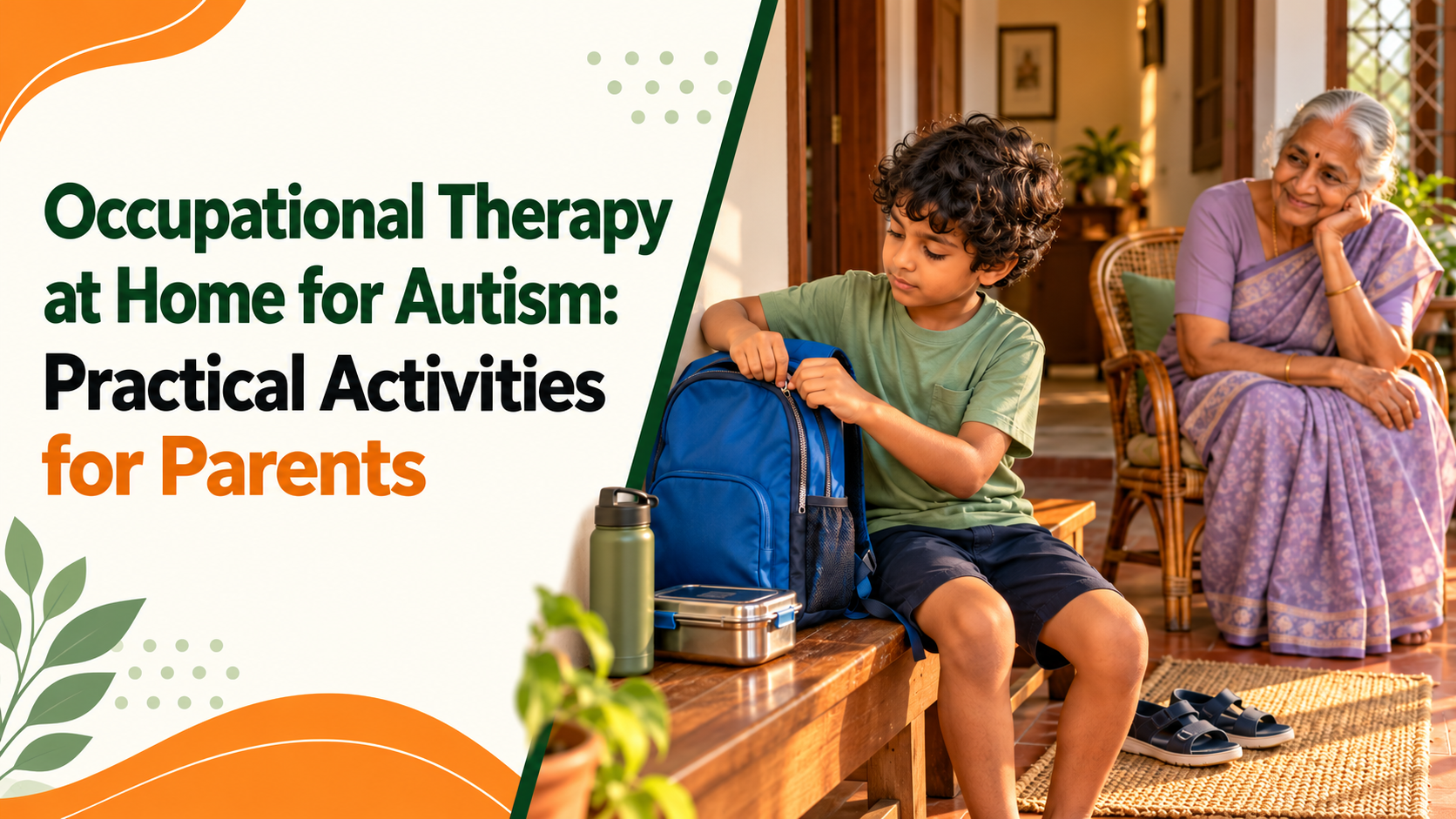
packs a school bag; or
washes their hands,
they are using skills that matter in real life.
These everyday tasks can involve coordination, sequencing, attention, motor control and problem-solving.
Instead of asking:
“What therapy activity should we do today?”
parents can sometimes ask:
“Which everyday activity would we like our child to participate in more independently?”
That creates a much clearer goal.
Occupational Therapy Activities at Home for Autism
The following ideas are examples of activities that can support commonly targeted functional skills.
They should be adapted according to the child's age, abilities, interests, safety and professional recommendations.
1. Clothespin Activities for Hand Strength
Give the child clothespins or safe pegs and encourage them to attach them around the edge of a container or piece of cardboard.
This simple activity involves:
finger strength;
hand-eye coordination;
grasp;
bilateral hand use; and
controlled release.
To make it more engaging, use a simple matching activity.
For example, the child can attach pegs to matching pictures or numbers.
For younger children or children who mouth objects, close adult supervision is important and small items should be avoided.
2. Play Dough for Fine Motor Skills
Play dough can provide many opportunities for hand use.
Instead of simply asking the child to “play with it,” try specific actions:
roll it into a ball;
flatten it;
pinch small sections;
make long shapes;
press safe cutters into it;
hide larger safe objects inside for the child to find.
These movements can encourage different patterns of hand and finger use.
The activity can also be adapted around the child's interests.
If they love vehicles, create roads.
If they enjoy animals, make animal shapes.
Motivation matters.
3. Sorting Household Objects
Sorting is an easy activity to incorporate into normal routines.
Ask the child to sort:
spoons and forks;
different coloured clothes;
toys;
large blocks;
socks;
stationery.
This can involve visual attention, categorization, coordination and following instructions.
It can also become functional.
Instead of creating an artificial sorting game, ask the child to help sort clean clothes before they are put away.
Now the activity contributes to a real household routine.
4. Pouring Water Between Containers
With supervision, allow the child to practise pouring water from one safe container into another.
Start with a small amount.
This activity can involve:
bilateral coordination;
grip;
visual attention;
control of movement; and
practical daily living skills.
Eventually, this can connect to functional goals such as pouring their own water at mealtimes.
Practise in a place where small spills are manageable so that the child is not made anxious about mistakes.
5. Opening and Closing Containers
Collect safe everyday containers with different opening mechanisms.
The child can practise:
unscrewing lids;
opening lunch boxes;
closing containers;
using simple zips;
opening Velcro fasteners.
These are practical hand skills that can support independence at school and home.
Rather than focusing on how quickly the child completes the task, focus on gradually reducing the amount of assistance required.
6. Dressing Practice
Getting dressed involves many separate skills.
If the complete task is difficult, break it into smaller parts.
For example:
Pick up the T-shirt.
Find the opening.
Put the head through.
Put one arm through.
Put the other arm through.
Pull the shirt down.
A child might initially complete only the final step.
Over time, parents can encourage participation in more steps.
Visual sequences with pictures may also help some children understand what comes next.
7. Button and Zip Practice
Buttons and zips can be challenging because they require coordination between both hands.
Instead of repeatedly practising when everyone is rushing to leave home, introduce the skill during a calmer period.
Start with:
larger buttons;
loose clothing;
larger zips;
dressing boards if recommended.
Then gradually practise the skill on the child's own clothing.
The ultimate goal is not completing an exercise board.
It is being able to participate more independently in dressing.
8. Helping in the Kitchen
The kitchen can offer useful supervised activities.
Depending on age and ability, a child may help:
wash vegetables;
carry lightweight items;
stir ingredients;
transfer ingredients using a spoon;
place food onto a plate;
wipe the table;
put safe utensils away.
These activities can involve coordination, sequencing, attention and daily living skills.
They also give the child a meaningful role within the family routine.
Safety must always come first. Children should not be given access to hot surfaces, sharp tools or other hazards beyond their abilities.
9. Laundry Activities
Laundry provides another practical learning opportunity.
A child might:
place clothes into a basket;
carry a light basket;
sort clothes;
match socks;
fold simple items;
place clothes into drawers.
Start with one manageable responsibility rather than expecting the child to complete the entire routine.
Small successes can gradually build independence.
10. Drawing, Colouring and Pre-Writing Activities
For children working toward handwriting, parents can introduce enjoyable fine motor and pre-writing activities.
Examples include:
drawing lines;
tracing simple shapes;
colouring larger pictures;
drawing in sand or another safe medium;
copying basic patterns;
using chalk on a board.
Avoid turning every activity into handwriting practice.
Some children become resistant when tasks feel repetitive or frustrating.
Using the child's interests can make participation more natural.
Sensory Activities for Autistic Children at Home
Sensory processing differences are common among autistic people, but the experience differs greatly between individuals.
A child may be particularly sensitive to noise while actively seeking movement.
Another may dislike certain clothing textures but enjoy strong physical activity.
This means there is no universal “sensory activity for autism” that every child needs.
The environment itself is often worth examining.
If a child struggles to participate in an activity, consider:
Is the room too noisy?
Is the lighting uncomfortable?
Is the child tired?
Is the clothing irritating?
Is the environment crowded?
Is the activity unpredictable?
Does the child understand what will happen next?
Sometimes modifying the environment can be more useful than adding another exercise.
Simple Movement Activities
Where appropriate and safe, everyday movement can include:
walking;
supervised playground activities;
dancing;
carrying appropriate lightweight household items;
simple obstacle courses;
throwing and catching a suitable ball.
Activities should be appropriate for the child's motor abilities and environment.
Movement should not be forced simply because an activity has been labelled “sensory.”
Create a Calm Space
Some children benefit from having access to a quieter area when they become overwhelmed.
A calm space does not need to be elaborate.
It might simply be a predictable area with reduced noise and fewer distractions where the child can regulate.
It should not be used as punishment.
The purpose is to give the child an environment that helps them feel comfortable enough to return to everyday activities when ready.
Do Not Assume Every Sensory Behaviour Needs to Be Stopped
Autistic children may use repetitive movements or behaviours, often called stimming, to regulate themselves or because the activity is enjoyable.
The aim should not automatically be to make the child appear less autistic.
If a behaviour is safe, understanding its purpose is important before trying to change it.
If behaviour is harmful to the child or others, or significantly affects everyday participation, seek appropriate professional guidance.
Activities for Daily Living Skills
One of the most useful areas of occupational therapy at home for autism is developing daily living skills.
These skills can contribute directly to independence.
Hand Washing
Turn hand washing into a predictable sequence:
Turn on the tap.
Wet hands.
Apply soap.
Rub hands.
Rinse.
Turn off the tap.
Dry hands.
A visual sequence near the sink may help some children.
Over time, reduce prompts when the child becomes more confident.
Tooth Brushing
Tooth brushing can involve motor, sensory and sequencing challenges.
If it is difficult, try to identify the specific problem.
Is the child uncomfortable with the toothbrush texture?
Is the toothpaste taste unpleasant?
Is the sequence unclear?
Is standing at the sink difficult?
Understanding the barrier helps determine what kind of support is appropriate.
Persistent difficulties should be discussed with relevant professionals, including dental professionals when necessary.
Mealtime Participation
Instead of focusing only on eating, consider other participation skills.
The child could:
carry their plate;
place a cup on the table;
use a spoon;
pour water;
clear the plate after eating;
wipe their place at the table.
These small responsibilities can gradually build practical independence.
How to Make Home Activities More Successful
The activity itself is only part of the equation.
How it is introduced matters.
Start With One Clear Goal
Avoid trying to improve everything at once.
Choose something meaningful.
For example:
Goal: My child will put their used plate near the sink after dinner.
That is clearer than:
Goal: Improve independence.
Specific goals are easier to practise and observe.
Break Tasks Into Smaller Steps
If a task seems difficult, identify its individual parts.
For example, packing a school bag could become:
Put the notebook inside.
Put the pencil case inside.
Put the lunch box inside.
Close the bag.
Teach manageable parts before expecting the complete routine.
Use Visual Support When Helpful
Some autistic children understand information more easily when they can see it.
Parents can use:
photographs;
picture sequences;
simple checklists;
visual schedules.
Visual support can also reduce the need to repeat verbal instructions.
Build Activities Around Interests
If a child loves trains, counting activities could involve trains.
If they love animals, fine motor activities could use animal pictures.
If they enjoy music, routines might incorporate familiar songs.
An activity that is technically useful but that the child refuses to participate in may achieve very little.
Engagement matters.
Give Enough Time
Adults often complete a task immediately when a child appears to struggle.
Sometimes support is necessary.
But when safe and appropriate, allowing a little extra processing and response time can give the child an opportunity to attempt the task.
Support can then be provided gradually.
What Parents Should Avoid
Home practice should not become a source of constant pressure.
Try to avoid:
forcing activities during distress;
comparing progress with other children;
using random “sensory exercises” without understanding their purpose;
expecting immediate results;
turning every part of the child's day into therapy;
repeatedly practising a task that is causing significant frustration;
assuming one strategy works for every autistic child.
Children need opportunities to learn.
They also need opportunities simply to play, relax and enjoy family life.
Home should not become a therapy clinic.
When Should You Consult an Occupational Therapist?
Consider seeking professional assessment when difficulties significantly affect everyday participation.
For example, a child may have persistent difficulty with:
dressing;
eating or mealtime participation;
handwriting or school tasks;
coordination;
fine motor activities;
self-care;
participating in routines;
tolerating everyday environments;
using common objects independently.
An occupational therapist can look beyond the visible difficulty and assess what may be contributing to it.
Professional paediatric OT guidance emphasizes understanding what matters to the child and family, assessing barriers to participation, setting goals and then providing strategies that can extend into home or school routines.
This is very different from giving every autistic child the same list of exercises.
Occupational Therapy and Early Intervention
Parents often begin looking for occupational therapy when they notice difficulties with everyday development.
Early identification of developmental needs can help families understand what support may be appropriate.
However, early intervention should not mean placing a child into every available therapy.
Support should be based on the child's assessed needs and meaningful developmental goals.
Parents who are still exploring developmental support can also read Prajha Trust's guide on Early Intervention for Autism: A Practical Guide for Parents.
Early support can involve a multidisciplinary approach depending on the child, including professionals such as occupational therapists, speech-language professionals, special educators, psychologists and developmental specialists.
How Prajha Trust Supports Children With Autism
Families often discover that a child's needs do not fit neatly into one category.
Communication may affect school participation.
Sensory differences may affect daily routines.
Motor difficulties may influence self-care.
Learning needs may affect independence.
This is why an integrated approach can be valuable.
Prajha Trust's Autism Academy in Chennai provides a structured environment that brings together areas including occupational therapy, speech therapy, special education, behaviour management, social skill development and applied daily living support.
Rather than looking only at isolated skills, the Academy focuses on helping children develop abilities that contribute to greater participation and independence.
Prajha Trust also recognizes the important role families play.
Through its Parent Training Academy, the organisation works to equip parents with knowledge and practical strategies they can use to create supportive home environments.
This connection between professional guidance and everyday family life is particularly important.
A skill learned during a structured session becomes far more meaningful when the child can use it at home, at school and eventually within the wider community.
Parents looking for structured developmental and educational support can explore the Prajha Trust Autism Academy to learn more about its integrated approach.
Frequently Asked Questions
Can occupational therapy for autism be done at home?
Parents can practise appropriately recommended OT-related skills at home through everyday activities and routines. Professional occupational therapy itself involves assessment, individualized goal setting and intervention by a qualified occupational therapist. Home activities should therefore support, rather than automatically replace, professional care when it is needed.
What are good occupational therapy activities for autism?
Useful activities depend on the child's goals. They may involve dressing, opening containers, using utensils, drawing, sorting household objects, preparing simple food, hand washing or other everyday tasks. Activities should be chosen because they support a meaningful skill, not simply because they are labelled as autism activities.
How long should OT activities be done at home?
There is no universal duration. Short activities incorporated naturally into everyday routines can sometimes be more practical than long sessions. Follow recommendations from the child's occupational therapist when a specific home programme has been prescribed.
What are good fine motor activities for autistic children?
Depending on age and ability, examples can include play dough, clothespins, drawing, opening containers, using safe utensils, sorting objects and practising buttons or zips. Activities should be supervised and adapted for the child's developmental level.
Do all autistic children need occupational therapy?
No. Autism does not automatically mean a child requires occupational therapy. OT may be appropriate when difficulties with motor skills, sensory differences, self-care, school participation or other everyday activities affect the child's ability to participate in meaningful routines.
Can occupational therapy improve independence?
Developing practical participation skills is an important area of occupational therapy. Depending on the individual's needs, goals may involve dressing, eating, school activities, personal care, household routines or other activities that contribute to greater independence.
Final Thoughts
When parents search for occupational therapy at home for autism, it is easy to find hundreds of activity lists.
But more activities do not necessarily mean better support.
Start with the child.
Ask:
What everyday activity is difficult?
Then ask:
What small skill would help my child participate more independently in that activity?
Perhaps the goal is opening a lunch box.
Perhaps it is washing hands.
Perhaps it is getting dressed with less assistance.
Perhaps it is participating comfortably in a family meal.
Those goals may look small from the outside, but they can make a meaningful difference to everyday life.
The most useful home support is therefore not about filling every hour with exercises. It is about creating appropriate, repeatable opportunities for children to practise meaningful skills in the places where those skills are actually needed.
For families seeking professional, educational and developmental support for autistic children, Prajha Trust provides integrated autism support through therapy, special education, daily living skills, parent empowerment and programs focused on greater independence.
Parents can explore the Prajha Trust Autism Academy and its family-support initiatives to understand what type of structured support may be appropriate for their child's individual needs.
For internal linking, I recommend linking “Prajha Trust Autism Academy” to the Academy page, “Early Intervention for Autism” to the existing early-intervention article, and “Parent Training Academy” to the About page where Prajha Trust explains that program. The Academy specifically lists occupational therapy, speech therapy, applied daily living and social-skill development, so these links are contextually relevant rather than inserted purely for SEO.
Prajha Trust Clinical Guidance & Support
Every child’s developmental milestones are unique. If you have questions regarding speech articulation, occupational motor therapy, or autism behavioral support, our dedicated clinical specialists are here to guide your family.
About Prajha Trust
Prajha Trust is a registered non-profit organization in Tamil Nadu dedicated to autism spectrum care, early intervention, occupational therapy, and fostering an inclusive society.