Skilling and Employment for Differently Abled Persons: Key Takeaways from a Stakeholder Workshop in Chennai
Creating meaningful employment opportunities for differently abled persons requires more than opening job vacancies. It requires the right skills, accessible workplaces, employer awareness, continued support and strong collaboration between government bodies, training institutions, industry and organisations working closely with communities.
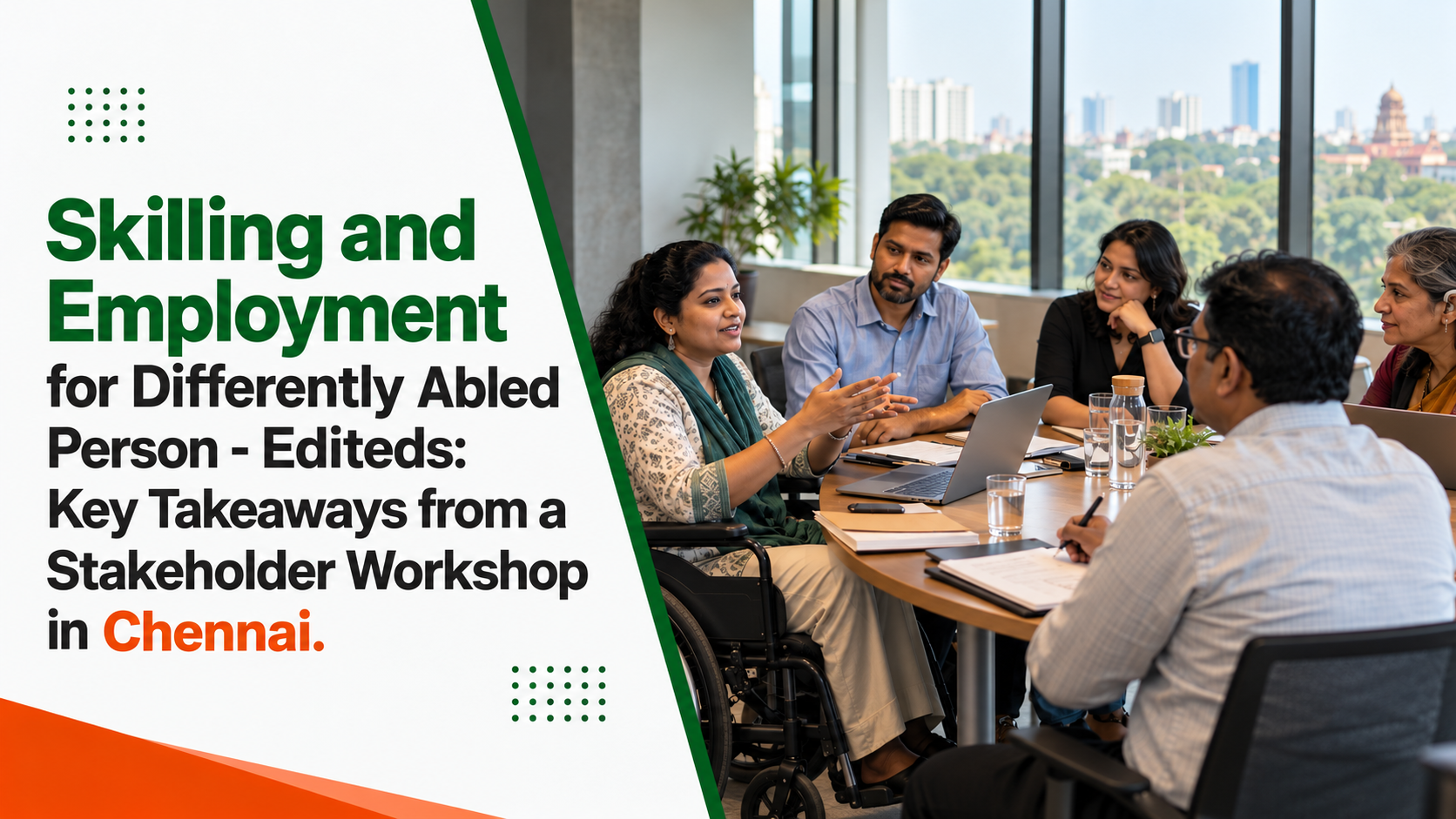
These important areas were at the centre of the Two-Day Stakeholder Workshop on Skilling & Employment of Differently Abled Persons, held on 22nd and 23rd September 2026 at Anna Centenary Library, Kotturpuram, Chennai.
Our organisation had the opportunity to participate in this stakeholder consultation, which brought together representatives from different sectors to discuss practical challenges and opportunities surrounding skill development, employment, workplace inclusion and sustainable career pathways for differently abled persons.
The discussions reinforced an important idea: inclusive employment is not achieved through recruitment alone. The complete journey—from identifying suitable skills and preparing candidates to supporting employers and ensuring long-term retention—needs attention.
Bringing Different Stakeholders into One Conversation
Employment challenges affecting differently abled persons cannot be addressed effectively by a single organisation or sector.
Training institutions may understand the skills candidates are developing, while employers understand current workplace requirements. Government departments can provide policy direction and support mechanisms, and organisations working directly with differently abled communities can contribute valuable insight into practical barriers faced by individuals.
Bringing these perspectives together helps identify the gaps between training, employability and actual employment opportunities.
The stakeholder workshop created an environment for discussions around areas such as industry-led job opportunities, skill requirements, curriculum and certification, placement and retention, workplace sensitisation, reasonable accommodation and job-coach support.
These are interconnected issues. Improving only one part of the employment journey may not produce sustainable outcomes unless the other challenges are addressed as well.

Suggested caption:
Stakeholders participating in discussions on skill development and employment opportunities for differently abled persons in Chennai.
Suggested alt text:
Stakeholder workshop on skilling and employment for differently abled persons in Chennai
Skill Development Must Connect with Real Employment Opportunities
Skill development becomes truly valuable when it leads to practical employment opportunities.
A training programme may successfully teach a skill, but candidates can still face difficulties finding suitable jobs if those skills do not align with current industry requirements.
This makes industry participation in skill development particularly important.
Employers can help training organisations understand what skills are currently required, what entry-level roles are available and what workplace expectations candidates should be prepared for.
At the same time, training programmes can prepare candidates not only with technical skills but also with workplace readiness, communication, confidence and other abilities required to transition into employment.
A stronger connection between training providers and employers can therefore reduce the gap between completing a course and successfully entering the workforce.
Employment Should Focus on Ability and Job Fit
Inclusive employment should begin with understanding what an individual can do, rather than allowing disability alone to define the opportunities available to them.
Different roles require different combinations of technical knowledge, communication abilities, mobility, concentration, creativity and interpersonal skills. Similarly, individuals have different strengths and support requirements.
The objective should therefore be to identify an appropriate match between the person's abilities, acquired skills and the requirements of a particular role.
This approach can benefit both employees and employers.
Candidates receive opportunities where they can meaningfully contribute, while employers gain access to a broader talent pool based on capability rather than assumptions.
Creating such matches requires employers, training organisations and employment-support systems to communicate effectively with one another.
Placement Is Only the Beginning
Securing a job is an important milestone, but successful inclusion does not end when an appointment letter is issued.
Retention is equally important.
A candidate may have the required technical abilities and still encounter challenges while adapting to a new workplace. These could involve communication, accessibility, transportation, unfamiliar workplace processes or a need for additional guidance during the initial employment period.
Employers may also need support in understanding how to create an inclusive working environment without unnecessarily treating an employee differently from the rest of the workforce.
This is why discussions about employment for differently abled persons should consider the entire employment lifecycle:
training → job matching → recruitment → onboarding → workplace support → retention → career development.
When each stage receives appropriate attention, employment has a better chance of becoming sustainable rather than temporary.
The Importance of Workplace Sensitisation
Physical accessibility is an important component of workplace inclusion, but inclusion also depends heavily on workplace culture.
Managers and colleagues may sometimes be uncertain about how to communicate or work with a colleague with a disability. In other situations, unconscious assumptions about someone's abilities can unintentionally restrict opportunities.
Workplace sensitisation can help address these barriers.
Employees and managers should understand that differently abled professionals are individuals with different capabilities, experiences and career ambitions—just like any other employee.
An inclusive workplace should encourage respectful communication, equal opportunity and an environment in which employees are assessed primarily on their ability to perform their roles.
This cultural aspect of inclusion can be just as important as infrastructure.
Reasonable Accommodation Can Remove Practical Barriers
Some employees may require adjustments that enable them to perform their jobs effectively.
Depending on the individual and the nature of the role, this might involve accessible infrastructure, assistive technology, modifications to a workstation, alternative communication methods or adjustments to particular work processes.
The purpose of reasonable accommodation is not to lower professional expectations.
Instead, it is about removing unnecessary barriers that prevent capable people from performing their work effectively.
The appropriate accommodation will naturally vary between individuals. Employers therefore benefit from having open conversations with employees rather than making assumptions about what support may be required.
Why Job-Coach and Continued Support Matter
One of the important areas surrounding inclusive employment is the support available during the transition from training to a real workplace.
For some candidates, guidance during the early stages of employment can make that transition smoother.
Job-coach or employment-support mechanisms can potentially help employees understand workplace routines, responsibilities and expectations while also helping employers address practical questions that arise during onboarding.
The requirement for such support will vary from person to person. However, where it is appropriate, continued guidance can help bridge the gap between getting a job and successfully settling into that job.
This is particularly important when the larger objective is sustainable employment rather than simply increasing placement numbers.
Collaboration Is Essential for Sustainable Inclusive Employment
One of the strongest themes emerging from stakeholder discussions such as this is the importance of collaboration.
Government agencies can create enabling policies and programmes. Training organisations can develop job-relevant skills. Employers can create opportunities. NGOs and organisations working directly with differently abled communities can provide important ground-level perspectives and support.
But these efforts become more effective when they are connected.
For example, employers communicating future skill requirements to training institutions can help programmes remain relevant. Training organisations sharing candidate capabilities with employers can improve job matching. Support organisations can help identify accessibility or transition challenges that might otherwise be overlooked.
This type of coordination can help move the conversation from isolated initiatives towards a more sustainable inclusive employment ecosystem.

Suggested caption:
Participants and stakeholders exchanging perspectives during the skilling and employment consultation in Chennai.
Suggested alt text:
Participants discussing inclusive employment opportunities for differently abled persons in Chennai
What We Took Away from the Stakeholder Consultation
Participating in the workshop provided an opportunity to listen to different perspectives surrounding the employment journey of differently abled persons.
A particularly important takeaway is that there is no single solution to inclusive employment.
Providing training without employment opportunities is insufficient. Creating vacancies without preparing candidates may not result in successful placements. Recruitment without workplace readiness and appropriate support can make long-term retention difficult.
These different elements need to work together.
The discussions also highlighted the importance of moving beyond a purely placement-focused approach. Successful employment should ultimately mean that an individual is able to contribute meaningfully, develop professionally and continue building a sustainable career.
For organisations and employers, this requires looking at inclusion not merely as a compliance requirement but as part of responsible and effective workforce development.
Creating More Inclusive Employment Pathways
India has a diverse talent pool, and expanding employment opportunities for differently abled persons requires a broader understanding of talent, accessibility and workplace inclusion.
Skill development is an important starting point, but its real impact is realised when skills translate into meaningful work.
Employers can contribute by evaluating roles based on actual job requirements, considering candidates according to their capabilities, improving workplace awareness and providing reasonable accommodations where appropriate.
Training institutions can continue strengthening the connection between their programmes and changing industry requirements.
Government departments, NGOs and other stakeholders can help create the support systems required to connect these different parts of the employment journey.
Most importantly, continued dialogue between all these groups can help identify practical challenges and develop solutions grounded in real workplace and candidate experiences.
Moving from Opportunity to Sustainable Employment
The Two-Day Stakeholder Workshop on Skilling & Employment of Differently Abled Persons in Chennai provided a valuable platform for discussing how skill development, industry participation, workplace inclusion and continued support can work together.
We were pleased to participate in the consultation and gain perspectives from the discussions among the various stakeholders present.
Building a more inclusive workforce will require continued cooperation, practical action and a willingness to recognise people's capabilities rather than defining their opportunities by limitations.
Every meaningful step towards accessible skill development, fair employment opportunities and inclusive workplaces can contribute to a future where more differently abled persons have the opportunity to build sustainable and rewarding careers.
Prajha Trust Clinical Guidance & Support
Every child’s developmental milestones are unique. If you have questions regarding speech articulation, occupational motor therapy, or autism behavioral support, our dedicated clinical specialists are here to guide your family.
About Prajha Trust
Prajha Trust is a registered non-profit organization in Tamil Nadu dedicated to autism spectrum care, early intervention, occupational therapy, and fostering an inclusive society.