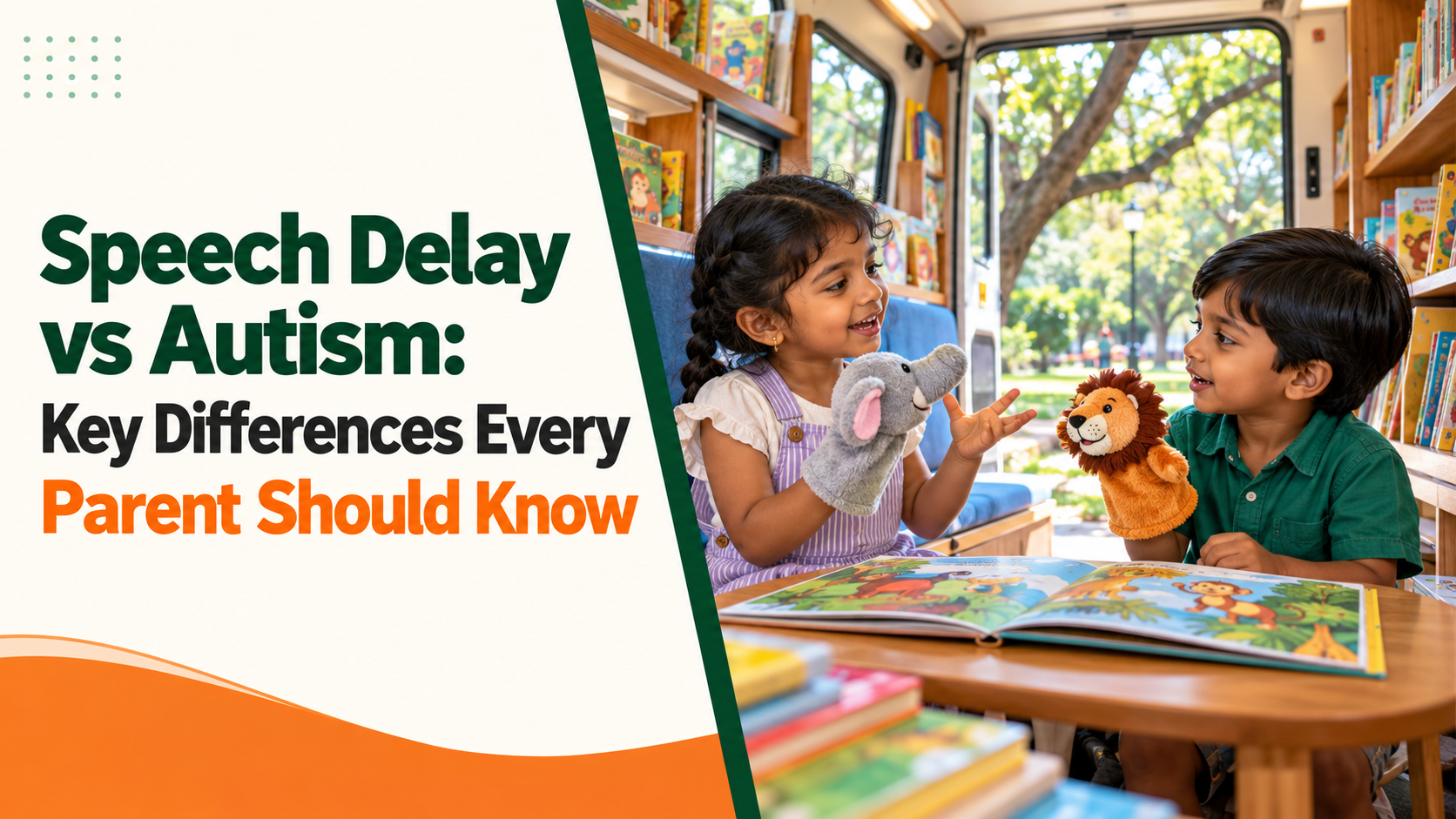
Your child isn't talking as much as the other kids. Maybe they've barely said any real words by 18 months, or they've hit two and still aren't putting sentences together. You're not panicking, but you're paying attention. And the question that keeps circling back is: is this a speech delay, or is it autism?
It's one of the most common and most loaded questions pediatricians hear. And the short answer to the one that actually helps you — is this: speech delay and autism are not the same thing. They can look similar on the surface. They can even occur together. But the signs that distinguish one from the other are specific, observable, and knowable well before a formal diagnosis land on your desk.
As of 2025, autism affects approximately 1 in 31 children in the United States, according to the CDC — a number that has climbed steadily over two decades, largely due to better screening and broader diagnostic criteria. Meanwhile, around 8% of young children experience some form of speech or voice disorder, making speech delay far more common than autism by a significant margin.
This article breaks down exactly what separates speech delay from Autism Spectrum Disorder (ASD) — by age, by behavior, and by what the research actually says. No vague reassurances. Just what you need to watch for, when to act, and what comes next.
The child who doesn't talk much but is pointing at airplanes, mimicking your expressions, and pulling you toward the toy they want? That's a very different situation from the child with limited words who also shows no interest in joint attention, plays with toys in the same repetitive sequence every day, and seems to look through people rather than at them.
What Is a Speech Delay, Really?
A speech delay means a child is developing language skills more slowly than expected for their age, but the developmental path itself remains typical. The trajectory is right; the pace is off. Most children with speech delays understand far more than they can express. That distinction matters enormously. A two-year-old who follows your instructions, points at the dog, laughs at your jokes, and drags you to the fridge when they want a snack — but only has ten words — is displaying a very different profile than a child who neither speaks nor responds to their own name.Common signs of speech delay by age:
- By 12 months: no babbling, not stringing consonant-vowel sounds ("mama," "dada"), not waving or pointing
- By 16–18 months: fewer than 10 words, heavy reliance on gestures instead of vocalizations
- By 24 months: fewer than 50 words, not combining two words ("more juice," "daddy go")
- By 3 years: not speaking in short sentences, strangers cannot understand most of what the child says
- By 4 years: cannot tell a simple story or form sentences of 4–5 words
What Is Autism Spectrum Disorder?
Autism Spectrum Disorder is a neurodevelopmental condition. The word "spectrum" is doing real work here — ASD ranges widely in how it presents, how severe its effects are, and what supports a person needs. Where a speech delay is a single-domain issue (language), autism affects multiple developmental domains simultaneously: communication, social interaction, sensory processing, and behavior. Speech delay is often one part of the autism picture — but it's never the whole picture. Research indicates that approximately 75% of children with ASD display language impairments by the time they reach kindergarten age. But a significant number of autistic children have no speech delay at all. They may speak fluently — just in ways that feel unusual, scripted, or socially disconnected. ApricottCore signs that point toward autism rather than isolated speech delay:
- Limited or absent joint attention — not pointing to share interest ("look at that bird!"), not following your pointed finger with their gaze
- Reduced eye contact, especially during social interaction
- Not responding to their name by 12 months, consistently
- Echolalia — repeating phrases from TV shows, songs, or previous conversations rather than generating original language
- Repetitive behaviors: hand-flapping, rocking, spinning objects, lining up toys
- Rigid routines — strong distress when the order of events changes even slightly
- Sensory differences — covering ears at moderate sounds, resisting certain textures, apparent under-sensitivity to pain
- Absent or delayed pretend play — not feeding a doll, not pretending a banana is a phone
Speech Delay vs Autism: The Differences Side by Side
The cleanest way to understand this distinction is through what the child is doing outside of speaking.| Feature | Speech Delay Only | Autism Spectrum Disorder |
| Social engagement | Seeks connection, makes eye contact, responds to affection | Reduced eye contact, may prefer solitary play, less social initiation |
| Pointing/gesturing | Uses gestures naturally to communicate and share | Limited pointing to share (protodeclarative pointing), may not develop gestures |
| Response to name | Responds reliably | Often does not respond, even by 12 months |
| Pretend play | Age-appropriate imaginative play despite limited words | Delayed or absent pretend play; may use toys in rigid, repetitive ways |
| Repetitive behavior | Not present | Hand-flapping, rocking, echolalia, fixation on specific topics/objects |
| Speech pattern | Typical but slower; mispronunciations, short phrases | May be absent, robotic, monotone, echolalic, or atypically formal |
| Prognosis | Many fully catch up with targeted speech therapy | Lifelong profile; early intervention produces significant gains but ASD remains |
Breaking It Down by Age: What to Watch at Each Stage
Speech Delay vs Autism at 12–18 Months
This is the window where the earliest autism signs tend to emerge. No babbling by 12 months is worth flagging. Children who are not saying any words by 16 months should be evaluated, even if everything else seems fine. Elevationautism For autism specifically, the 12–18 month period may reveal: no waving, no pointing, no back-and-forth babbling with caregivers, not sharing facial expressions, and not responding to their name being called — not once, not twice, not most of the time. A child with a speech delay, by contrast, will typically do most of these things. They're just not talking much yet. The M-CHAT-R (Modified Checklist for Autism in Toddlers) is a validated screener used at 18-month well-child visits. If your pediatrician hasn't mentioned it, ask.Speech Delay vs Autism at 2 Years Old
Around the age of 18 months to two years, speech and language delays become most noticeable, which is why this is typically when parents start seeking answers. Autism Parenting Magazine At two, a child with isolated speech delay is still connecting. They're playing imaginatively, making eye contact, bringing you their favorite toy to share, reacting to other children with curiosity. They just may not have words for most of it. An autistic child at two may have some words, or none — but the social pieces are also missing or atypical. They may have had words and lost them. That regression of previously acquired skills is a significant red flag that warrants immediate evaluation.Speech Delay vs Autism at 3–4 Years Old
By three and four, speech delays become more visible to everyone — teachers, other parents, relatives. A child with speech delay at this age is working on articulation, building vocabulary, learning to tell stories. They want to talk; they're just struggling with the mechanics. An autistic child at four who has had therapy may actually be talking quite a bit by now. But the quality of communication can still stand out: using memorized scripts in conversation, difficulty with back-and-forth exchange, taking language very literally, or struggling to understand what the other person is feeling or thinking. At four, social play differences become more apparent. Autistic children may prefer to play near peers rather than with them, struggle with cooperative games that require reading implicit social cues, or become dysregulated when play doesn't follow expected patterns.Level 1 Autism and Speech Delay
Level 1 autism spectrum disorder previously called Asperger's Syndrome before the DSM-5, consolidated in the diagnostic categories is the most nuanced case for parents trying to distinguish speech delay from autism. Children with Level 1 ASD often have age-appropriate or even advanced vocabulary. What's affected is how they use language: a tendency toward monologue over dialogue, difficulty with humor and sarcasm, very literal interpretation of figures of speech, and a conversational style that can come across as oddly formal or one-sided. The "speech delay" label rarely applies here — but subtle communication differences absolutely do.Can a Child Have Both a Speech Delay and Autism?
Yes, and this is common. Around 74% of individuals with ASD experience at least one additional developmental or medical condition. A child can have a clinically significant speech delay as part of their autism profile, or they can have a speech delay caused by a separate factor (like hearing loss) while also being autistic. The fact that they overlap is exactly why the diagnostic picture needs to go beyond language milestones. Evaluating speech alone doesn't answer the autism question. A comprehensive developmental evaluation covering language, social communication, play, behavior, and sensory processing is what produces a reliable answer.How to Fix Speech Delay at Home: What Actually Helps
Whether you're waiting for a professional evaluation or have already started therapy, there are evidence-backed strategies that support language development at home. Talk constantly — and narrate everything. "I'm opening the fridge. Here's your milk. Cold milk." Running commentary builds vocabulary in context. Research consistently shows that the quantity and quality of language a child is exposed to directly affects their development. Read together, every day. Not passively — interactively. Point at pictures, wait for your child to respond, ask simple questions, let them turn the pages. Even 15 minutes of responsive shared reading daily makes a measurable difference. Follow the child's lead. Whatever they're focused on — that toy car, that patch of sunlight — get down to their level and talk about it. Joint attention scaffolded around the child's interest is one of the most powerful drivers of language growth. Reduce screen time. Passive screen time does not develop speech. Live, face-to-face interaction with responsive adults is what does. Get hearing tested. Before drawing any other conclusions, confirm your child's hearing. Undetected hearing loss is one of the most common causes of speech delay and is entirely treatable. For autism, Applied Behavior Analysis (ABA), Speech-Language Therapy, and Occupational Therapy remain the most widely studied and supported interventions. Early intensive therapy — particularly before age five — is associated with significantly better long-term outcomes.When to Stop Waiting and Seek an Evaluation
Trust your gut. But here are the specific signals that warrant a call to your pediatrician or a referral to a developmental pediatrician or speech-language pathologist (SLP):- No babbling by 12 months
- No single words by 16 months
- No two-word combinations by 24 months
- Any loss of previously acquired language or social skills at any age
- No pointing, waving, or back-and-forth play by 12 months
- Not responding to their name consistently by 12 months
- Rigid, repetitive behaviors that are intensifying rather than decreasing
Quick Reference: Should You Be Concerned?
If your child is doing all of these things, an isolated speech delay is more likely:- Makes eye contact during play and interaction
- Points at things to share interest (not just to request)
- Responds when you call their name
- Engages in pretend play
- Seeks connection with you and other familiar people
- Shows joint attention — follows your gaze or pointed finger
The Bottom Line
Speech delay and autism can look similar at 18 months when all your measuring is word count. But look beyond the words at how the child connects, plays, shares attention, and responds to the world around them, and the picture become much clearer. A child who isn't talking much but is socially engaged, pointing, making eye contact, and inviting you into their world is showing you something important: the social-communication framework is intact. A speech delay is likely, and therapy can help enormously. A child who isn't talking and is also not connecting socially, not pointing to share, not responding to their name, and engaging in repetitive behaviors needs a different kind of evaluation one that goes well beyond what a hearing test or basic vocabulary screen can capture. Either way, the right response is the same: get professional input early, advocate loudly for your child, and don't wait for school age to act. The children who receive targeted support in the toddler years consistently show better outcomes than those who don't. That's the clearest finding in the research, and it's the most useful thing you can take from this page.Frequently Asked Questions
Can a child have a speech delay and not be autistic?
Absolutely. The majority of children with speech delay do not have autism. Speech delay can be caused by hearing impairment, oral-motor issues, prematurity, multilingual environments, cognitive differences, or simply a natural variation in development. A speech delay alone does not indicate ASD.Why is my child not talking at 2 years old?
There are many possible reasons, ranging from hearing loss to late talking to underlying developmental conditions. The most important step is to get a comprehensive evaluation that includes hearing testing and a developmental screening. A two-year-old without words warrants professional assessment — not panic, but action.What is the tone of voice in autism?
Many autistic children and adults have atypical prosody — the rhythm, pitch, and melody of speech. This can present as a flat or monotone delivery, an unusual accent, an overly formal or scripted style, or difficulty modulating volume and intonation to match the social context. This is distinct from speech delay; a child can have plenty of words and still have atypical vocal tone as part of their autism profile.What is Level 1 autism and does it involve speech delay?
Level 1 ASD (what was previously called "high-functioning autism" or Asperger's) often does not involve a true speech delay. Children may have age-appropriate or advanced vocabulary. What's affected is pragmatic language — how they use language in social contexts, understand implied meaning, and navigate conversation as a two-way exchange rather than a monologue.What is the autism speech delay treatment approach?
For autistic children with speech delays, treatment typically involves speech-language therapy focused on functional communication, often combined with ABA therapy. Augmentative and Alternative Communication (AAC) tools — including picture boards and speech-generating devices — are increasingly used alongside verbal speech development rather than as a replacement for it. Early, intensive, individualized therapy produces the best outcomes.Prajha Trust Clinical Guidance & Support
Every child’s developmental milestones are unique. If you have questions regarding speech articulation, occupational motor therapy, or autism behavioral support, our dedicated clinical specialists are here to guide your family.
About Prajha Trust
Prajha Trust is a registered non-profit organization in Tamil Nadu dedicated to autism spectrum care, early intervention, occupational therapy, and fostering an inclusive society.