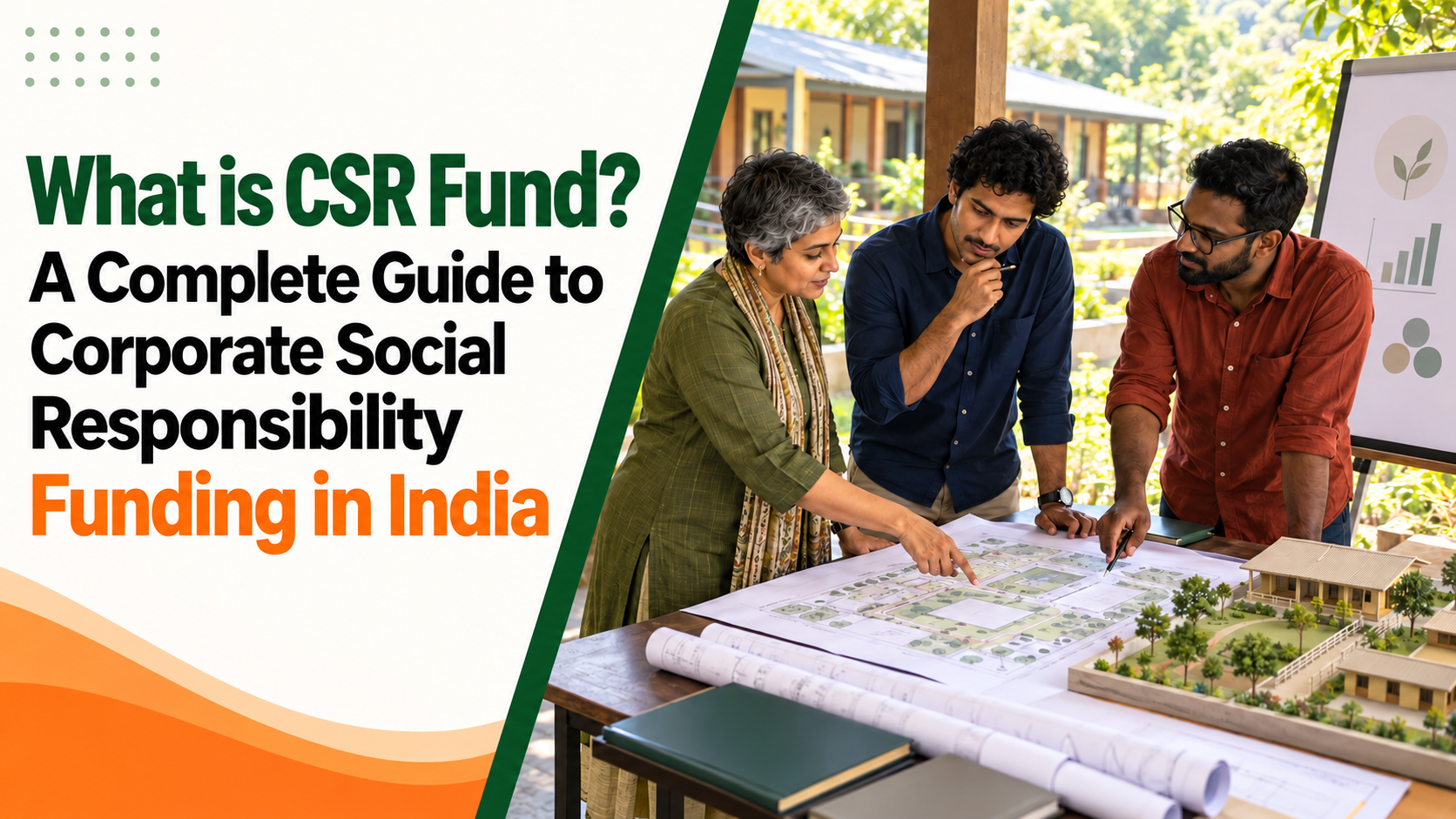
What Is a CSR Fund? A Complete Guide to CSR Funding in India

A CSR fund is the budget that an eligible company allocates to approved social and environmental projects under India’s Corporate Social Responsibility framework. It may support education, healthcare, disability inclusion, skill development, women’s empowerment, environmental protection, rural development, disaster relief, and other activities permitted under the Companies Act.
In my experience working with community initiatives, CSR funding is most useful when it supports a clearly defined need rather than a one-day activity designed only to complete an annual target. A well-planned project can help a school improve learning access, enable children with autism to receive structured support, strengthen preventive healthcare in an underserved community, or help young people develop employable skills.
This guide explains what CSR funding means, which companies must comply with CSR provisions, who can receive funds, how CSR-1 registration works, and how an NGO can approach companies with a credible proposal. I will also explain the practical checks that corporate CSR teams usually make before approving a partnership.
What Is a CSR Fund?
A CSR fund is the amount set aside by a qualifying company for activities permitted under Section 135 and Schedule VII of the Companies Act, 2013.
The CSR framework is administered by the Ministry of Corporate Affairs. It requires eligible companies to plan their CSR expenditure, approve projects through the appropriate governance process, monitor implementation, and disclose relevant information.
From a field perspective, I would describe CSR funding as structured corporate giving. It differs from an informal donation because the company must connect its expenditure to an eligible activity, maintain documentation, and demonstrate how the project was implemented.
A typical CSR project therefore includes a defined problem, beneficiaries, location, activities, budget, timeline, monitoring indicators, and reporting process.

Why CSR Funding Matters in India
CSR funding helps connect corporate resources with organisations that understand local communities. Government systems remain central to education, healthcare, disability welfare, and rural development, but nonprofit organisations can often help identify service gaps, mobilise communities, test practical solutions, and reach beneficiaries who require additional support.
For example, a healthcare project in Chennai may complement public-health efforts by conducting awareness sessions, screening camps, referrals, or follow-up support in low-income neighbourhoods. NGOs working in this space should study the National Health Mission and relevant Tamil Nadu health programs before designing a proposal. The National Health Mission covers rural and urban health systems and aims to improve access to affordable, equitable, and quality healthcare.
Similarly, an education project should begin by understanding what schools, teachers, children, and parents actually need. Providing tablets may look attractive in a proposal, but the intervention will have limited value if teachers are not trained, internet access is unreliable, or learning progress is not measured.
In autism support, I have observed that awareness alone is rarely enough. Families may also need guidance on assessment, therapy options, inclusive education, parent support, referrals, and long-term planning. The World Health Organization describes autism as a diverse group of conditions related to brain development and notes that the abilities and support needs of autistic people vary considerably.
Which Companies Must Spend on CSR?
Section 135 applies when a company meets at least one of the following thresholds during the immediately preceding financial year:
Financial criterion | Threshold |
Net worth | ₹500 crore or more |
Turnover | ₹1,000 crore or more |
Net profit | ₹5 crore or more |
A qualifying company is generally required to spend at least 2% of the average net profits made during the three immediately preceding financial years on eligible CSR activities.
Companies should calculate their exact obligation with their finance, legal, and compliance professionals because the Companies Act and CSR Rules contain provisions relating to computation, unspent amounts, ongoing projects, administrative overheads, surplus, reporting, and Board responsibility.
The practical point for NGOs is that a company’s CSR budget is not an unrestricted pool of money. Each expenditure must fit the company’s CSR Policy, annual action plan, legal obligations, geographic preferences, and approval process.

What Is the Difference Between CSR Funding and a Donation?
CSR funding and charitable donations may support similar causes, but they operate differently.
CSR funding | Charitable donation |
Governed by the Companies Act and CSR Rules | Usually voluntary |
Must relate to eligible CSR activities | May support a wider range of charitable purposes |
Requires corporate approval and reporting | May involve a simpler approval process |
Often includes defined outputs and outcomes | May not require formal impact indicators |
Usually involves an agreement, budget and monitoring | May be given without a detailed implementation plan |
When I prepare or review a CSR proposal, I look for project logic rather than emotional language alone. A credible proposal should explain what the problem is, who is affected, what the organisation will do, how much it will cost, and how improvement will be measured.
I have also explained the wider value of philanthropy in our guide on why charitable giving matters.
What Activities Are Eligible Under Schedule VII?
Schedule VII provides the broad categories under which CSR activities may be undertaken. Companies and NGOs should study the official wording before finalising a project rather than assuming that every charitable activity automatically qualifies.
Education and skill development
CSR projects may support education, special education, vocational skills, livelihood enhancement, school infrastructure, teacher training, scholarships, digital learning, and employment-oriented training.
A strong education proposal should not stop at inputs such as computers, books, or classrooms. It should explain how those inputs will improve attendance, teaching quality, learning levels, course completion, or employability.
For example, a digital-learning project in a government or low-income school in Tamil Nadu should first assess electricity, internet connectivity, teacher readiness, language requirements, device maintenance, and student access. These checks prevent expensive equipment from becoming unused after the launch event.
I have explained the long-term value of educational support in our guide on supporting child education through structured community programs.
Healthcare and sanitation
Healthcare CSR initiatives may include preventive healthcare, maternal and child health, nutrition, sanitation, screenings, mobile health services, mental-health awareness, community education, and support for underserved populations.
Before proposing a medical camp, I recommend identifying what happens after screening. A camp that detects a health concern but provides no referral pathway, counselling, follow-up, or treatment linkage may create awareness without solving the beneficiary’s next problem.
NGOs can review official programs and operational guidance through the National Health Mission. When working in Tamil Nadu, they should also coordinate with local public-health institutions, government hospitals, urban primary health centres, and district authorities where appropriate.
Autism and disability inclusion
CSR support may be used for eligible projects involving special education, disability inclusion, early intervention, therapy support, caregiver training, assistive technology, vocational development, awareness, and accessible community services.
Autism projects require particularly careful design because every child’s strengths and support needs differ. I recommend involving qualified professionals, parents, special educators, and community stakeholders while defining the intervention.
The project should clearly explain:
- How beneficiaries will be identified
- Which professionals will deliver services
- How consent and privacy will be protected
- How individual progress will be recorded
- What referrals will be available
- How parents and teachers will be involved
- What happens after the funding period
Organisations can also consult the National Trust, which works for persons with autism, cerebral palsy, intellectual disability, and multiple disabilities. Its website includes registration and program-related information for eligible organisations.
I have discussed this subject further in our guide on how corporate funding can strengthen autism education.
Women’s empowerment and livelihoods
CSR initiatives may support women’s education, health, financial literacy, entrepreneurship, self-help groups, employability, and livelihood development.
In practice, training alone is not a sufficient outcome. A tailoring, digital-skills, or entrepreneurship project should examine whether participants have access to markets, equipment, mentoring, finance, transport, childcare, and continued support.
Environmental and rural development
Eligible projects may address water conservation, sanitation, renewable energy, biodiversity, waste management, village infrastructure, agriculture-related livelihoods, and environmental sustainability.
The strongest projects begin with local evidence. For instance, a water project should assess the source, seasonal availability, maintenance responsibility, water quality, community ownership, and long-term operating cost before constructing infrastructure.
Who Can Receive CSR Funding?
Companies may carry out CSR activities directly or through eligible implementing agencies. Depending on the applicable conditions, these may include:
- Registered Public Charitable Trusts
- Registered Societies
- Section 8 Companies
- Entities established by government
- Other organisations permitted under the CSR Rules
A Trust is generally created through a trust deed for charitable purposes. A Society is a membership-based nonprofit structure registered under the applicable Societies Registration law. A Section 8 Company is a nonprofit company incorporated under the Companies Act for charitable or socially beneficial objectives.
Legal registration alone does not make an organisation ready for CSR funding. Companies also examine governance, finances, leadership, project experience, safeguarding, policies, documentation, and reporting capacity.
In practical due diligence, I commonly expect an organisation to have:
- Registration documents
- PAN
- CSR-1 registration
- 12A and 80G records, where applicable
- Audited financial statements
- Annual reports
- Governing-body details
- Bank information
- Project reports
- Policies on finance, procurement, safeguarding and conflicts of interest
- Evidence of previous implementation
Some companies also review an organisation’s profile on NGO DARPAN, which is managed under NITI Aayog. The portal provides a DARPAN ID based on the information submitted by an NPO; it does not issue a physical certificate.
How to Complete CSR-1 Registration

Most eligible implementing agencies that undertake CSR projects on behalf of companies must file Form CSR-1 and obtain a CSR Registration Number.
The purpose of CSR-1 is to help the government and companies identify registered implementing agencies and strengthen accountability.
Step 1: Confirm that your organisation is eligible
Before starting the filing, review the applicable CSR Rules or ask a practising Chartered Accountant, Company Secretary, or Cost Accountant to confirm eligibility.
Check the organisation’s legal structure, registration history, charitable objects, and relationship with any sponsoring company or government entity.
A common mistake is to assume that CSR-1 alone creates eligibility. The organisation must first satisfy the legal conditions applicable to its category.
Step 2: Prepare the required documents
Keep the organisation’s registration certificate, PAN, trust deed or constitutional documents, governing-body details, email address, authorised-signatory information, and Digital Signature Certificate ready.
Check that the organisation’s name, PAN, registration number, and address are consistent across every document. Even minor differences can delay professional verification or create questions during corporate due diligence.
Step 3: File through the MCA system
Visit the Ministry of Corporate Affairs website and access the MCA filing services. Search for Form CSR-1, enter the organisation’s registration and authorised-signatory details, and complete the required declarations.
The form must be digitally signed and professionally certified where required. NGOs should not submit information they do not fully understand. Ask the certifying professional to explain any legal declaration before signing.
Step 4: Retain the CSR Registration Number
After successful submission and processing, retain the acknowledgement and CSR Registration Number in the organisation’s compliance folder.
Include this number in funding proposals and due-diligence documents because corporate CSR teams commonly request it before considering an implementing partnership.
Registration is only the first compliance step. It does not guarantee funding or replace the need for credible projects, proper governance, and transparent reporting.
How Does the CSR Funding Process Work?
From my experience, CSR funding usually follows a structured sequence rather than beginning with an immediate grant.
1. The company defines its CSR priorities
Companies first identify sectors, locations, beneficiaries, budgets, and outcomes based on their CSR Policy, annual action plan, operational areas, and social priorities.
An IT company may support digital education or employability, while a manufacturing company may focus on communities around its plants through healthcare, water, livelihood, or environmental projects.
2. The NGO identifies the right company
Review the company’s official website, CSR Policy, annual report, sustainability report, and previous projects. The National CSR eXchange Portal may also help corporates and implementing agencies understand CSR opportunities and development sectors.
Look for alignment between your organisation’s actual experience and the company’s priorities. Do not change your mission merely to fit a funding opportunity.
3. The NGO prepares a project proposal
A practical CSR proposal should explain:
- The community problem
- Evidence supporting the need
- Target beneficiaries and location
- Project activities
- Implementation team
- Timeline
- Detailed budget
- Outputs and outcomes
- Risks
- Monitoring process
- Sustainability plan
Avoid objectives such as “help children with autism.” A better objective would specify how many children or families will be supported, which services will be delivered, for how long, by whom, and how progress will be assessed.
4. The company conducts due diligence
The CSR team may review legal documents, audited accounts, policies, leadership experience, previous projects, references, and beneficiary records. It may also conduct a site visit.
NGOs should answer questions honestly. A smaller organisation with disciplined systems is often more credible than a larger organisation that cannot explain its budget or outcomes.
5. Both parties finalise the agreement
The agreement or Memorandum of Understanding should define the approved budget, activities, milestones, reporting schedule, payment terms, branding, data protection, safeguarding, ownership of assets, and treatment of unspent funds.
Read every clause carefully. A common mistake is to start implementation before agreeing on how changes, delays, cost variations, and beneficiary data will be handled.
6. The project is implemented and monitored
Maintain attendance records, beneficiary information, consent forms, bills, vouchers, photographs, activity reports, and progress data from the beginning.
Do not wait until the final month to collect evidence. Reliable reporting depends on a monitoring system that is built into daily implementation.
7. Outcomes and funds are reported
A report should explain what was planned, what was completed, how funds were used, what changed, what challenges arose, and what should happen next.
For example, “five awareness sessions were conducted” is an output. An outcome would show whether participants improved their understanding, sought referrals, changed a practice, or accessed a service.
How Companies Choose CSR Projects
Companies select CSR projects based on strategic fit, legal compliance, budget, location, and expected impact. From my experience, a good cause alone is not enough; the proposal must clearly match the company’s CSR priorities and show that the NGO can implement the project responsibly.
CSR Policy Alignment
Companies first check whether the project matches their CSR Policy and the activities allowed under Schedule VII. NGOs should review the company’s website, annual report, and sustainability report before applying.
Geographic Relevance
Many companies prefer projects near their offices, factories, or operational locations. A company in Tamil Nadu may prioritise projects in Chennai, Coimbatore, Hosur, or nearby districts.
Budget and Project Scale
The proposal must fit the company’s approved CSR budget. NGOs should present a realistic, transparent budget and avoid inflated costs or unclear lump-sum expenses.
ESG and SDG Alignment
Projects connected to education, healthcare, disability inclusion, livelihoods, or environmental sustainability may also support the company’s ESG goals and relevant Sustainable Development Goals.
Governance and Capacity
Companies review CSR-1 registration, audited accounts, previous projects, governance, monitoring systems, and reporting capacity before selecting an NGO.
Board Approval
The proposal may be reviewed by the CSR team, senior management, CSR Committee, and Board before final approval. NGOs should therefore expect due diligence and respond promptly to document or clarification requests.
How Can NGOs Improve Their Chances of Receiving CSR Funding?
Begin by strengthening the organisation before approaching companies. Keep registrations current, complete annual filings, maintain audited accounts, document projects, and establish clear internal policies.
Next, prepare proposals for specific companies rather than sending a generic document to hundreds of CSR teams. Show that you have studied the company’s priorities and can explain why your project fits.
Use local evidence wherever possible. For a Chennai-based autism initiative, this may include interviews with parents, discussions with schools, service-access gaps, referral challenges, and data from your existing community work.
Finally, present a realistic budget. Include qualified staff, training, travel, monitoring, accessibility, safeguarding, materials, documentation, and follow-up. Under-budgeting may make a proposal appear attractive initially, but it often damages service quality during implementation.
Documents Commonly Required for CSR Funding

Prepare a digital due-diligence folder containing:
- CSR-1 acknowledgement and number
- PAN
- Registration Certificate
- Trust Deed, Society documents, or Section 8 documents
- 12A and 80G registrations
- Audited accounts
- Annual reports
- Trustee, director, or governing-body details
- Bank details and cancelled cheque
- Organisational policies
- Team profiles
- Project proposal
- Detailed budget
- Previous project reports
- Utilisation certificates
- Impact evidence
For 12A, 80G, Form 10A, Form 10B, and donation-reporting requirements, use the official Income Tax Department portal and consult a qualified tax professional. The portal provides official manuals for charitable institutions, including Form 10B and Forms 10BD and 10BE.
Why CSR Proposals Commonly Fail
A proposal usually becomes weak when it contains a broad problem, an activity list, and a lump-sum budget without showing how the activities will create change.
Other frequent problems include expired registrations, inconsistent documents, unrealistic beneficiary numbers, weak monitoring, unclear staff qualifications, poor safeguarding, and no continuation plan.
I also advise NGOs not to hide operational challenges. If staff retention, community participation, referrals, permissions, or transport may affect the project, explain the risk and the mitigation plan. Corporate teams generally prefer a realistic proposal to an overconfident one.
Why Prajha Trust Focuses on Responsible CSR Partnerships
At Prajha Trust, we approach CSR projects by first understanding the community need, the people affected, the existing services, and the gap that a partnership can realistically address.
Our areas of work include education, autism awareness and support, special-needs inclusion, healthcare awareness, child and family welfare, fundraising, volunteer engagement, and community development.
In autism-related projects, we believe beneficiary dignity must guide every decision. This means obtaining appropriate consent, protecting personal information, avoiding stigmatising language, using photographs responsibly, involving families, and working with qualified professionals.
We also encourage companies to contribute through employee volunteering, technology, professional skills, awareness support, mentoring, and infrastructure where these inputs genuinely strengthen the project.
Organisations interested in partnership opportunities can learn about our approach through our autism support services.
Frequently Asked Questions
1) Is CSR mandatory in India?
CSR provisions apply to companies that meet at least one of the financial thresholds under Section 135. Their exact responsibilities depend on the Companies Act, CSR Rules, financial calculations, project status, and Board obligations.
2) Can any NGO receive CSR funding?
No. The organisation must have an eligible legal structure, satisfy the applicable CSR Rules, complete CSR-1 registration where required, and pass the company’s due-diligence process.
3) Can a newly registered NGO apply?
A new NGO may be legally eligible, but companies often look for implementation experience. A new organisation should begin with well-documented pilot projects, credible professionals, clear policies, transparent accounts, and measurable results.
4) Can CSR funding support autism initiatives?
Yes, properly designed projects involving disability inclusion, special education, healthcare, early intervention, caregiver support, awareness, accessibility, and skill development may fall within eligible Schedule VII areas.
5) Does CSR-1 guarantee funding?
No. CSR-1 establishes registration as an implementing agency where applicable. Companies will still examine project alignment, governance, finances, experience, risk, and expected impact.
6) How long does CSR approval take?
There is no fixed period. Approval may take weeks or months depending on the company’s annual funding cycle, due diligence, legal review, site visits, internal committees, and budget availability.
Conclusion:
A CSR fund is a regulated corporate allocation used for eligible social and environmental projects. For companies, responsible CSR requires legal compliance, careful partner selection, transparent monitoring, and meaningful outcomes.
For NGOs, the path to CSR funding begins with eligibility, CSR-1 registration where required, complete documentation, credible field experience, a well-researched proposal, realistic budgeting, and measurable impact.
From my experience, the strongest CSR partnerships are built when both parties understand the community problem clearly and agree on what responsible success looks like. When corporate resources, professional implementation, and community participation are aligned, CSR funding can create improvements that continue well beyond the original grant period.
Prajha Trust Clinical Guidance & Support
Every child’s developmental milestones are unique. If you have questions regarding speech articulation, occupational motor therapy, or autism behavioral support, our dedicated clinical specialists are here to guide your family.
About Prajha Trust
Prajha Trust is a registered non-profit organization in Tamil Nadu dedicated to autism spectrum care, early intervention, occupational therapy, and fostering an inclusive society.