Introduction
Speech therapy for autism helps children develop the communication skills they need to express their needs, understand others, build relationships, and participate more confidently in everyday life. Communication is much more than speaking. It also includes understanding language, using gestures, interpreting facial expressions, taking turns in conversations, and, for some children, communicating through Picture Exchange Communication System (PECS) or Augmentative and Alternative Communication (AAC) devices. From my experience working with children and families at Prajha Trust, one of the biggest concerns parents share is not knowing whether their child's communication differences are part of typical development or whether professional support is needed. Every autistic child communicates differently. Some children may have limited spoken language, while others speak fluently but struggle with social communication, understanding emotions, or maintaining conversations. This is why speech therapy should always be individualised rather than following the same approach for every child. Research consistently shows that early identification and intervention can improve communication, participation, and long-term developmental outcomes. However, speech therapy can also benefit older children, teenagers, and adults when communication challenges continue to affect daily life. The goal is not to change who a child is, but to help them communicate in ways that are meaningful, comfortable, and effective. In this guide, I'll explain how speech therapy works for autistic children, when to seek an assessment, common therapy techniques, practical activities parents can use at home, how often therapy may be needed, and how to choose the right Speech-Language Pathologist (SLP) in India. Related Reading: If you would like to understand the everyday communication and developmental challenges autistic children may experience, explore our detailed guide on Autism Challenges: Daily Life, Classroom, Symptoms & Support.What Is Speech Therapy for Autism?
Speech therapy for autism is a specialised intervention that helps children improve speech, language, social communication, and everyday interaction. It supports more than spoken words and may include understanding language, expressing needs, interpreting social cues, and using gestures, pictures, PECS, or AAC when needed. Autistic children can have very different communication profiles. Some may speak fluently but struggle with conversations, emotions, or social situations. Others may use limited words, repeat phrases, or depend on visual communication. Speech therapy may help children:- Understand and use language
- Improve speech clarity and vocabulary
- Ask and answer questions
- Develop conversation and turn-taking skills
- Understand facial expressions and body language
- Use non-verbal or alternative communication systems
What Does a Speech Therapist Do?
A speech therapist, or Speech-Language Pathologist (SLP), assesses a child’s communication strengths and challenges before creating an individualised therapy plan. The assessment may cover:- Understanding and using language
- Speech clarity and vocabulary
- Social communication
- Play, attention, and listening skills
- Non-verbal communication
- Oral-motor, feeding, or swallowing concerns when relevant
How Speech Therapy Helps Children with Autism
Speech therapy helps children with autism develop practical communication skills that support learning, relationships, emotional regulation, and independence. When a child cannot express needs or understand what others expect, communication difficulties may lead to frustration or behavioural challenges. Depending on the child’s needs, therapy may begin with foundational skills such as:- Responding to their name
- Making requests
- Pointing or using gestures
- Following simple instructions
- Taking turns
- Developing joint attention
- Understanding routines
- Building sentences
- Answering questions
- Understanding emotions
- Joining conversations
- Managing communication breakdowns
- Developing classroom and friendship skills
- Understanding humour or figurative language
Who Can Benefit from Speech Therapy?
Speech therapy can benefit children across the autism spectrum, including those who speak fluently. It may be helpful when a child has difficulty understanding language, expressing thoughts, following instructions, joining conversations, or interpreting social cues. Children may benefit from speech therapy if they:- Have delayed speech or limited vocabulary
- Struggle to understand or use language
- Repeat words or phrases through echolalia
- Find it difficult to ask questions or maintain conversations
- Have challenges with gestures, facial expressions, or body language
- Are minimally verbal, non-speaking, or use AAC
- Have speech sound difficulties
- Need communication support at preschool or school
Why Do Children with Autism Need Speech Therapy?
Children with autism may experience communication differences that affect speech, language understanding, social interaction, and non-verbal communication. Some children begin speaking later, while others speak fluently but struggle with conversations, emotions, tone of voice, facial expressions, or social cues. Speech therapy provides personalised, evidence-based support for challenges such as:- Understanding and using language
- Expressing wants, needs, and emotions
- Starting and maintaining conversations
- Interpreting gestures, facial expressions, and tone
- Adjusting communication in different situations
- Participating in classroom and social interactions
Signs Your Child May Need Speech Therapy
Every child develops communication skills at their own pace, but persistent communication difficulties should not be ignored. Early assessment can help identify communication challenges and provide timely support before they affect learning, relationships, and daily life. At Prajha Trust, we've met many parents who initially believed their child would "start talking when they're ready." While that may be true for some children, delaying an assessment can also delay access to early intervention. If your child shows several of the following signs over time, consider consulting a Speech-Language Pathologist or developmental paediatrician.Limited Vocabulary
If your child uses significantly fewer words than expected for their age or struggles to learn and use new words meaningfully, speech therapy can help identify the underlying communication challenges. Related Reading: Learn more about early developmental signs in our Common Virtual Autism Symptoms in Young Children article.Difficulty Following Simple Instructions
Children who frequently struggle to understand simple instructions despite having normal hearing may have receptive language difficulties. Speech therapy helps improve language comprehension and listening skills.Repeating Words or Phrases (Echolalia)
Many autistic children repeat words, questions, or movie dialogues they hear. This is called echolalia and is often a stage of language development rather than simply repetitive speech. A speech therapist helps children use language more meaningfully over time. External Resource: The American Speech-Language-Hearing Association provides information about echolalia and language development.Rarely Initiating Conversations
Some children respond when spoken to but rarely start conversations, ask questions, request help, or share experiences. Speech therapy encourages spontaneous communication through play-based and everyday interactions.Limited Eye Contact or Joint Attention
Rather than encouraging prolonged eye contact, speech therapists focus on joint attention—helping children share attention with another person during communication, such as looking between a parent and a favourite toy or picture. Related Reading: Our guide on Autism Challenges: Daily Life, Classroom, Symptoms & Support explains how communication differences affect everyday situations.Limited Use of Gestures
Gestures such as pointing, waving, nodding, or showing objects are important early communication skills. Children who use very few gestures may benefit from speech therapy to strengthen their communication foundation.Other Signs
You may also consider an assessment if your child:- Responds inconsistently to their name
- Has difficulty expressing emotions
- Becomes frustrated during communication
- Has limited pretend play
- Finds it difficult to answer simple questions
- Relies mainly on memorised phrases
- Struggles with classroom or social communication
Benefits of Speech Therapy for Autism
Speech therapy helps children strengthen expressive and receptive language, expand vocabulary, improve speech clarity, ask and answer questions, follow instructions, and express their needs. For minimally verbal or non-speaking children, communication may also involve PECS, AAC devices, gestures, or visual supports.Improves Communication Skills
Speech therapy helps children strengthen expressive and receptive language, expand vocabulary, improve speech clarity, ask and answer questions, follow instructions, and express their needs. For minimally verbal or non-speaking children, communication may also involve PECS, AAC devices, gestures, or visual supports.Builds Social Interaction
Many autistic children find social communication challenging. Speech therapy teaches practical skills such as taking turns, greeting others, asking questions, understanding facial expressions, recognising emotions, and participating in conversations, helping children build stronger relationships at home and school.Builds Confidence
As communication improves, children often become more confident in expressing their thoughts, making choices, asking for help, and participating in everyday activities. Even small communication milestones can have a positive impact on self-esteem.Supports Learning
Communication skills play an important role in classroom learning. Speech therapy helps children understand instructions, answer questions, participate in discussions, and communicate more effectively with teachers and classmates. Related Reading: If you're exploring suitable learning environments, our guide on Autism Academies in Chennai explains the support available for autistic children.Reduces Communication Frustration
Children who struggle to express their needs may become frustrated or overwhelmed. By providing effective communication strategies, speech therapy helps children express feelings, preferences, and needs more clearly, reducing communication-related stress for both children and families.Encourages Greater Independence
Strong communication skills enable children to make choices, ask for assistance, follow routines, and participate more confidently in everyday activities, supporting greater independence as they grow.Strengthens Family Relationships
When communication improves, everyday interactions become easier and more meaningful. Parents often find it easier to understand their child's needs, emotions, and interests, leading to stronger family connections.Supports Long-Term Development
Communication skills developed during childhood continue to support education, friendships, employment, and independent living. Early speech therapy helps build a strong foundation for lifelong participation and quality of life. Related Reading: Learn how schools continue to support communication development in our guide to Top Special Schools in Chennai for Children with Autism Spectrum Disorder.Common Speech Therapy Techniques for Autism
Speech therapy for autism is personalised to each child's communication strengths, developmental stage, and goals. A Speech-Language Pathologist (SLP) often combines several evidence-based techniques to help children communicate more effectively in everyday situations.Picture Exchange Communication System (PECS)
PECS helps children communicate by exchanging pictures to request objects, activities, or express needs. As communication develops, children may progress from making simple requests to answering questions, building sentences, and initiating conversations. Some children eventually develop spoken language alongside PECS, while others continue using it as part of their communication system.Augmentative and Alternative Communication (AAC)
AAC includes communication methods that support or replace spoken language, such as communication boards, picture cards, speech-generating devices, and tablet-based communication apps. AAC does not prevent speech development and can provide children with reliable ways to communicate while language skills continue to grow. External Resource: The American Speech-Language-Hearing Association provides evidence-based guidance on AAC and communication support.Play-Based Therapy
Play-based therapy uses activities such as toys, books, puzzles, pretend play, and games to encourage communication in natural, enjoyable situations. Through play, therapists help children develop vocabulary, turn-taking, social interaction, and language skills.Social Stories
Social Stories prepare children for everyday situations by explaining routines, expectations, and appropriate communication in a simple and structured way. They are commonly used for activities such as starting school, visiting a doctor, taking turns, or interacting with peers.Modelling and Language Expansion
Instead of asking children to repeat words, therapists model appropriate language and naturally expand the child's communication. For example, if a child says "Car," the therapist may respond, "Yes, that's a big red car," helping the child learn richer vocabulary and sentence structure.Joint Attention Activities
Joint attention activities encourage children to share focus with another person during communication, such as looking at a picture book together or pointing to an object. These skills support language development, social interaction, and early communication.Parent Coaching
Parent coaching helps families reinforce communication throughout daily routines such as meals, playtime, reading, and shopping. At Prajha Trust, we've found that children often make the greatest progress when therapists and families work together to practise communication beyond the therapy session.12 Speech Therapy Activities Parents Can Try at Home
One of the questions parents ask us most often at Prajha Trust is, "What can I do at home to help my child communicate better?" The good news is that communication doesn't only develop during therapy sessions. Everyday routines such as meals, story time, shopping, bath time, and play provide valuable opportunities to practise speech and language skills naturally. These simple activities are designed to complement professional speech therapy, not replace it.1. Animal Sound Imitation
Use toy animals or picture books to model sounds like moo, woof, meow, and roar. Encourage your child to imitate the sounds at their own pace. Helps develop:- Sound imitation
- Vocabulary
- Listening skills
- Turn-taking
2. Read Picture Books Together
Choose books with colourful pictures and simple sentences. Pause during reading and encourage your child to point, gesture, answer questions, or describe what they see.3. Sing Nursery Rhymes
Songs with repetition, such as Twinkle Twinkle Little Star or Old MacDonald Had a Farm, encourage children to anticipate words and gradually join in. Pause before familiar words to invite participation.4. Name Everyday Objects
During daily routines, naturally name objects such as cups, shoes, spoons, soap, or toothbrushes. Repeated exposure helps children connect words with real-life experiences.5. Bubble Play
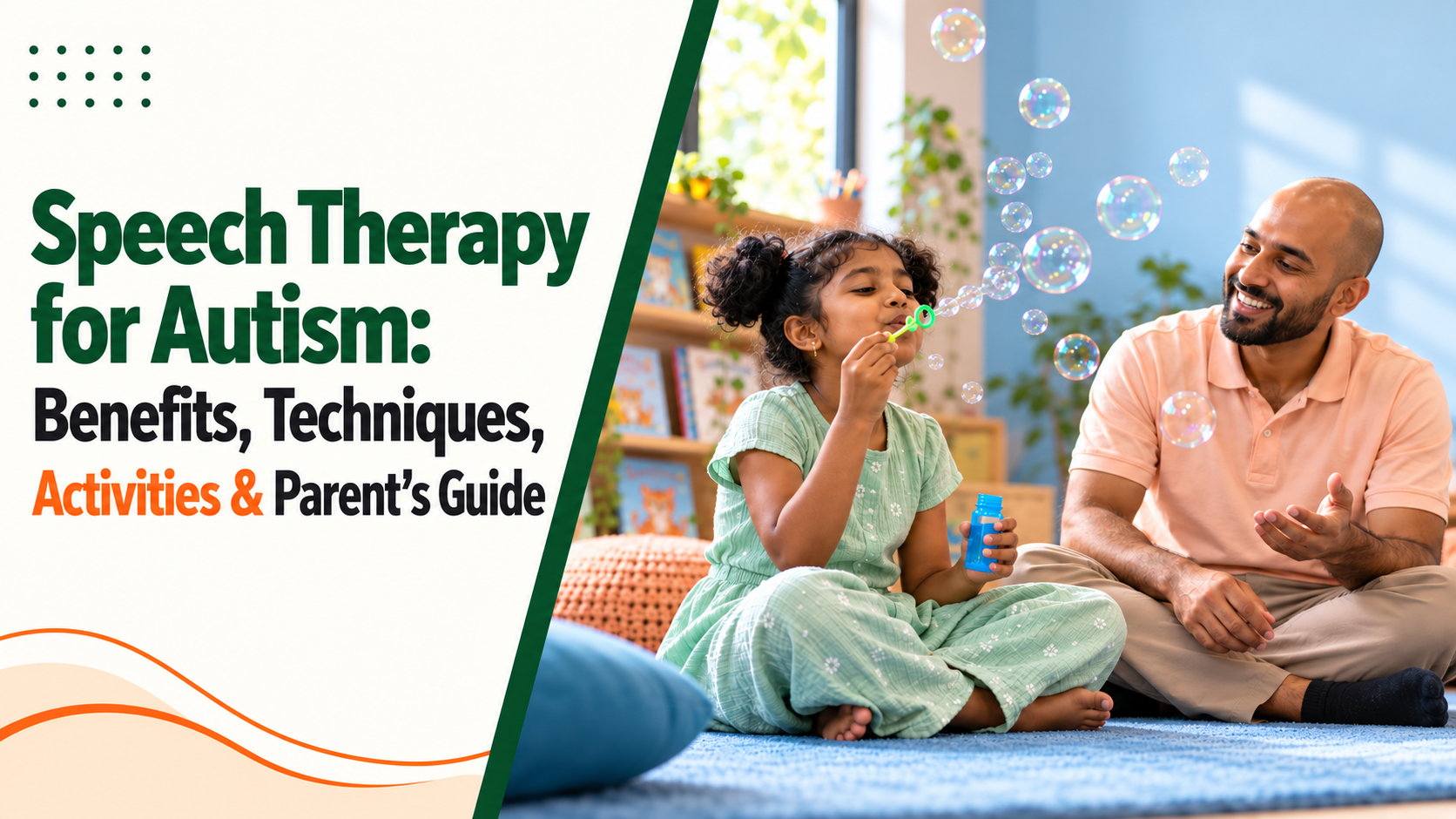
Pause before blowing bubbles and wait for your child to communicate by looking, pointing, gesturing, or using words. Helps develop:- Requesting
- Joint attention
- Turn-taking
- Communication initiation
6. Interactive Flashcards
Use flashcards to ask simple questions rather than testing memory. For example:- Find the banana.
- Show me the red one.
- Which animal says "meow?"
7. Mirror Activities
Stand together in front of a mirror and practise smiling, blowing kisses, making facial expressions, and simple speech sounds. Mirror play helps children observe how communication works.8. Communication Boards
Offer picture choices for snacks, toys, or activities so your child can communicate preferences even if spoken language is still developing.9. Pretend Play
Role-play everyday situations such as shopping, visiting a doctor, ordering food, or attending school. These activities naturally encourage conversation and social communication.10. Choice-Making Games
Offer meaningful choices instead of yes-or-no questions. Examples:- Juice or milk?
- Blue ball or red ball?
11. Sensory Play
Activities using play dough, water, sand, rice bins, or finger painting create opportunities to introduce descriptive words such as soft, wet, cold, big, and small while keeping communication enjoyable.12. Ask Open-Ended Questions
As your child's communication develops, ask questions that encourage longer responses. Instead of: "Did you enjoy the park?" Try: "What did you enjoy at the park?"Tips for Parents
- Keep activities fun and pressure-free.
- Celebrate every communication attempt.
- Give your child enough time to respond.
- Reduce distractions during practice.
- Follow your child's interests.
- Repeat new words naturally throughout the day.
- Practise consistently with patience.
When Should Speech Therapy Start?
Speech therapy should begin as soon as persistent communication concerns are identified. Early intervention can support language, social interaction, and learning during the years when children are developing rapidly. However, speech therapy is not limited to toddlers. Preschool children, school-age children, teenagers, and young adults may also benefit when communication difficulties affect learning, relationships, or independence. The right starting point depends on the child’s individual needs, not age alone. If you are concerned about your child’s speech, language understanding, or social communication, consult a qualified Speech-Language Pathologist for an assessment. Related Reading: Learn more about early developmental concerns in our guide on Common Virtual Autism Symptoms in Young Children.How Often Does a Child Need Speech Therapy?
The frequency of speech therapy depends on the child’s communication needs, age, goals, attention span, progress, and any additional developmental challenges. After an assessment, the Speech-Language Pathologist may recommend:- One session per week
- Two sessions per week
- A more intensive programme when clinically appropriate
How Parents Can Support Speech Therapy at Home
Parents play an important role in reinforcing the communication skills children learn during professional speech therapy. The goal is not to conduct formal therapy at home, but to create regular, positive opportunities for communication throughout the day. Parents can support progress by:- Reading together and discussing pictures or stories
- Talking during meals, play, travel, and other daily routines
- Giving the child enough time to respond
- Encouraging words, gestures, pictures, pointing, or AAC
- Praising every meaningful communication attempt
- Reducing passive screen time and increasing interaction
- Practising the specific goals recommended by the therapist
- Sharing observations and progress with the therapy team
How to Choose the Right Speech Therapist
Choosing the right speech therapist is an important step in supporting your child's communication development. A qualified Speech-Language Pathologist (SLP) should not only work with your child but also guide your family throughout the therapy journey. When choosing a speech therapist, consider the following:Qualifications and Experience
Look for a Speech-Language Pathologist with recognised qualifications, relevant professional registration where applicable, and experience working with autistic children. The therapist should be familiar with verbal, minimally verbal, and non-speaking children, as well as communication approaches such as PECS, AAC, and parent coaching.Child-Centred Approach
A good therapist should assess your child's individual strengths and communication needs before creating personalised therapy goals. During sessions, they should use engaging, play-based activities, respect your child's pace, and review progress regularly instead of following a fixed programme.Parent Involvement
Parents play an important role in communication development. Choose a therapist who explains therapy goals clearly, demonstrates home activities, answers questions, and encourages regular communication between therapy sessions.Practical Considerations
Also consider factors such as:- Clinic location
- Appointment availability
- Child-friendly environment
- Online consultation options when appropriate
- Collaboration with schools and other professionals involved in your child's care
Speech Therapy vs Occupational Therapy
Many parents ask us whether their child needs speech therapy, occupational therapy, or both. This is a common question because communication, sensory processing, play, and everyday life skills often develop together. While the two therapies have different goals, they frequently complement each other when supporting autistic children. From my experience at Prajha Trust, many children benefit from receiving both therapies. For example, a child may work with a Speech-Language Pathologist to communicate wants and needs while working with an occupational therapist to improve sensory regulation, attention, or fine motor skills that make communication and daily activities easier.| Speech Therapy | Occupational Therapy |
| Improves communication skills | Improves daily living skills |
| Develops expressive and receptive language | Supports sensory processing |
| Enhances speech clarity | Improves fine motor skills |
| Builds conversation and social communication | Develops self-care skills such as dressing and feeding |
| Supports vocabulary and language understanding | Improves hand-eye coordination |
| Uses AAC, PECS, and communication strategies | Supports emotional regulation through sensory strategies |
| Helps children express needs and emotions | Helps children participate independently in daily routines |
How They Work Together
Many autistic children benefit from both therapies because communication and daily functioning are closely connected. For example: A child may work with a speech therapist to request a snack using words or picture cards while simultaneously working with an occupational therapist to improve the fine motor skills needed to hold a spoon independently. Similarly, sensory regulation strategies taught in occupational therapy can improve a child's ability to participate and engage during speech therapy sessions. Rather than viewing these therapies as alternatives, many families find that they complement one another and support the child's overall development.Common Myths About Speech Therapy for Autism
Misconceptions about speech therapy can delay children from receiving the support they need. Here are some common myths and the facts behind them.Myth 1: Children Will Eventually "Grow Out" of Speech Delays
Fact: While some children develop language later than others, persistent communication delays should be assessed by a qualified Speech-Language Pathologist. Early assessment helps identify communication needs and allows children to access appropriate support as early as possible.Myth 2: Only Non-Speaking Children Need Speech Therapy
Fact: Speech therapy benefits children across the autism spectrum. Even children who speak fluently may need support with conversation, social communication, understanding emotions, interpreting facial expressions, or using language appropriately in different situations.Myth 3: Speech Therapy Only Teaches Children to Talk
Fact: Speech therapy supports all aspects of communication, including understanding language, listening, gestures, facial expressions, social interaction, PECS, AAC, and conversation skills. The goal is effective communication, not spoken language alone.Myth 4: AAC Prevents Children from Learning to Speak
Fact: Research shows that Augmentative and Alternative Communication (AAC) does not stop speech development. Instead, it provides children with a reliable way to communicate, often reducing frustration while supporting language development. External Resource: The Centers for Disease Control and Prevention provides reliable information on autism, early intervention, and developmental support.Frequently Asked Questions
1) Can Speech Therapy Cure Autism?
No. Autism is a lifelong neurodevelopmental condition. Speech therapy does not cure autism, but it can improve communication, language, social interaction, and everyday participation.2) How Long Does Speech Therapy Take?
There is no fixed duration. It depends on the child’s needs, goals, age, progress, therapy consistency, and home practice. The therapist should review the plan regularly and adjust it when necessary.3) Can Non-Speaking Children Benefit From Speech Therapy?
Yes. A speech-language pathologist may use AAC devices, PECS, gestures, visual supports, or communication boards to help a child communicate effectively.4) Can Parents Practise Speech Therapy at Home?
Parents can reinforce professional therapy through reading, singing, play, choices, and conversations during daily routines. Home activities should follow the child’s therapy goals rather than replace professional assessment and treatment.5) What Age Is Best to Start Speech Therapy?
Support should begin when persistent communication concerns are identified. Early intervention can be beneficial, but autistic children, teenagers, and adults may also benefit from speech-language therapy.Conclusion
Speech therapy for autism helps children develop meaningful ways to communicate, whether through spoken language, gestures, PECS, AAC, or a combination of communication methods. Strong communication skills support learning, relationships, emotional well-being, and greater independence throughout life. From my experience working with children and families at Prajha Trust, I have seen that meaningful progress is built through early assessment, personalised therapy, regular home practice, and close collaboration between parents, teachers, and therapists. Every child develops differently, so success should always be measured against the child's own starting point rather than comparisons with others. If you have ongoing concerns about your child's communication, don't wait for the difficulties to resolve on their own. Booking an assessment with a qualified Speech-Language Pathologist can help you understand your child's strengths, identify areas that need support, and create an individualised therapy plan that encourages long-term communication and participation in everyday life.Prajha Trust Clinical Guidance & Support
Every child’s developmental milestones are unique. If you have questions regarding speech articulation, occupational motor therapy, or autism behavioral support, our dedicated clinical specialists are here to guide your family.
About Prajha Trust
Prajha Trust is a registered non-profit organization in Tamil Nadu dedicated to autism spectrum care, early intervention, occupational therapy, and fostering an inclusive society.